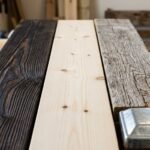
You might think intarsia, fitting different wood pieces together like a puzzle to create pictures, requires advanced skills, but it doesn’t.
I’m here to show you how to start simple with contrasting woods and basic tools.
Before you worry about tackling complex designs, let’s explore what actually makes a beginner-friendly pattern work and which woods will make your first project really stand out.
What Is Intarsia and Why Start With It
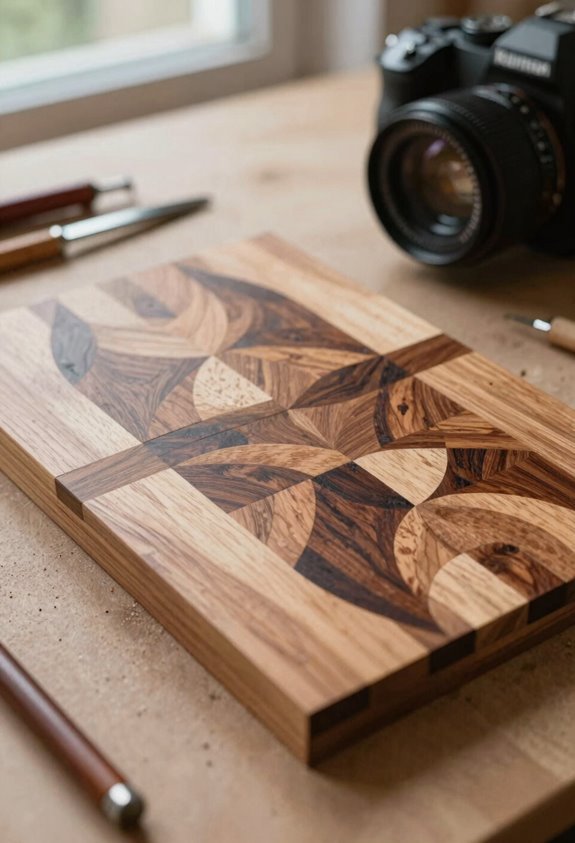
Have you ever wondered how woodworkers create images that seem to pop right off the wood surface? That’s intarsia, a woodworking technique using inlaid wood pieces to build pseudo 3-D images. Instead of painting or staining, craftspeople rely on natural wood grain and color variations for depth and texture.
I’d recommend starting with intarsia because it’s accessible. You’ll learn fundamental skills: layout, cutting, fitting, and finishing. Simple projects like leaping dolphins or 14-piece patterns work perfectly for beginners.
What makes intarsia special? Multiple wood species combine to create subtle shading and cohesive images. You’re joining a community that values authentic craftsmanship, a modern revival that gained momentum during the 1970s. You’ll discover that wood’s natural beauty speaks louder than any stain ever could.
Choose Your First Project: Beginner-Friendly Patterns
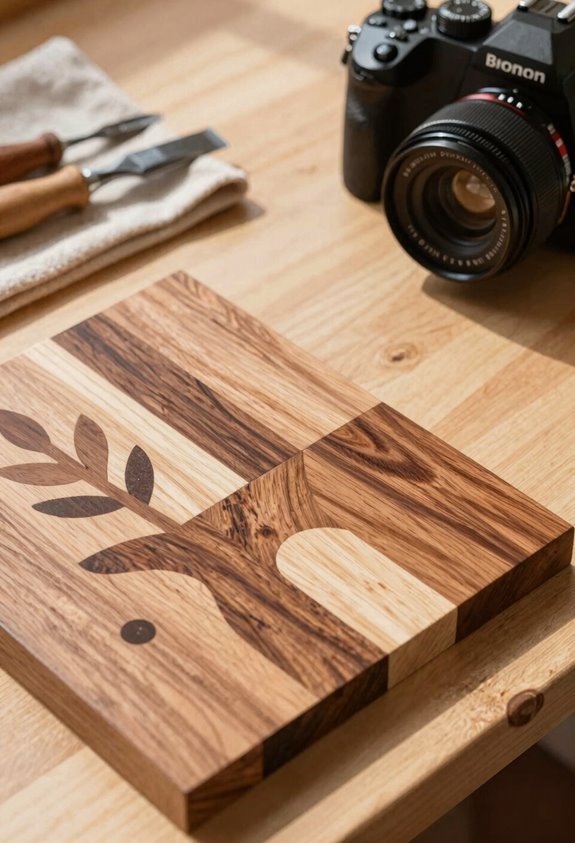
Picking the right starter project helps you succeed in your intarsia journey. You’ll want something that builds confidence without overwhelming you. I recommend these approachable options:
Picking the right starter project builds confidence without overwhelming you in your intarsia journey.
- The Whale – A simple 12″ x 9″ design with just 7 pieces, perfect for practicing fundamental skills
- Leaping Dolphins – A 14-piece pattern from Judy Gale Roberts’ *Easy To Make Intarsia* that teaches layout, cutting, fitting, and finishing
- Multiple size options – Large, medium, and regular dimensions let you choose your comfort level
- Themed variety – Seasonal, wildlife, and nautical designs match your interests
Before starting, you’ll trace intarsia patterns onto wood after making 4–5 copies. Keep a spare master pattern nearby for reference.
Choose softer woods initially. They’re easier to cut and more forgiving as you develop your skills.
Choose Intarsia Woods by Grain and Color Contrast
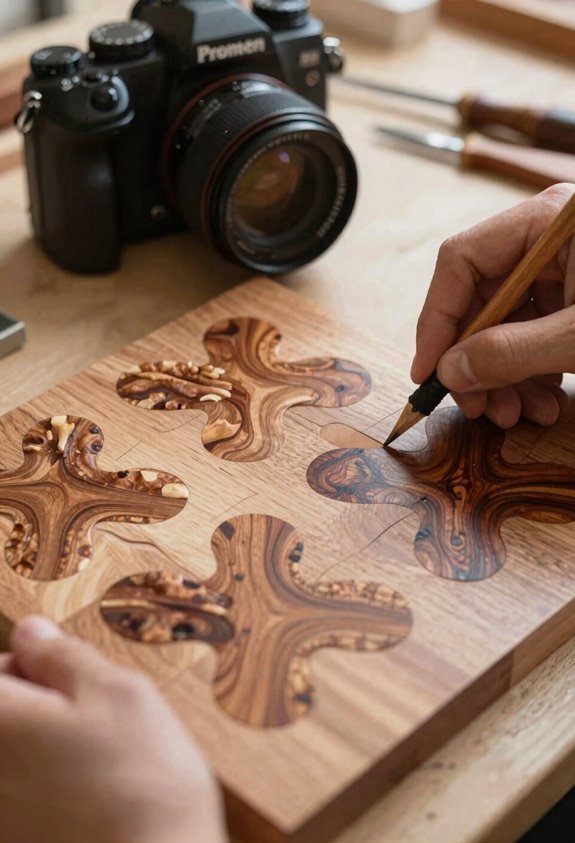
Because wood grain and color work together to create a striking 3-D effect in intarsia, you’ll want to choose your materials carefully from the start.
Pair Contrasting Colors
I recommend selecting light and dark woods together. Walnut paired with Holly, or Padauk with Poplar, creates natural color contrast that makes pieces stand out without staining.
Match Grain Direction
Align each wood’s grain pattern with your design’s contours. This grain flow enhances depth and dimension, making flat surfaces feel rounded.
Avoid Busy Patterns
Skip heavily figured woods for backgrounds; they’ll compete with your details. Instead, use plain woods as backgrounds and reserve decorative species for focal points where they’ll shine.
Consider Workability
Denser woods cut cleanly for sharp edges but require sharper tools. Softer woods are easier to work, making them ideal for beginners learning technique.
Transfer Your Pattern and Number Each Piece
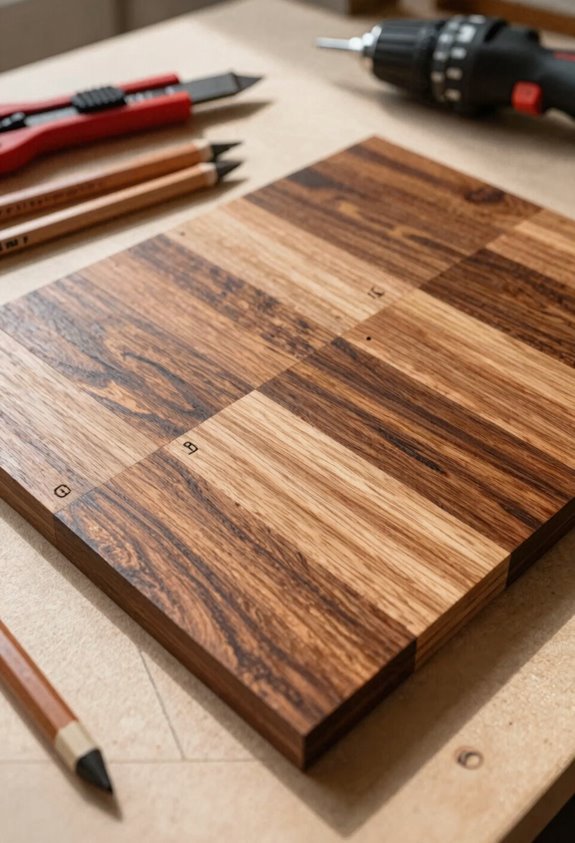
How many pattern copies do you really need before you start cutting? I’d say grab 4–5 copies minimum. Here’s why this matters for your success:
- One copy stays on the wood using blue tape and pattern glue to guide your cutting
- One reference copy sits nearby so you’re not constantly checking the taped version
- Two backup copies protect you if mistakes happen during cutting
- Number each piece or organize by color to track which goes where during reassembly
Pattern placement determines everything. Keep that taped copy positioned exactly where pieces’ll sit on your wood. This prevents shifting during cutting and ensures accurate fit between adjacent parts.
Numbering brings order to the process. You’ll thank yourself during assembly when you’re matching dozens of pieces together.
Essential Intarsia Tools You’ll Need
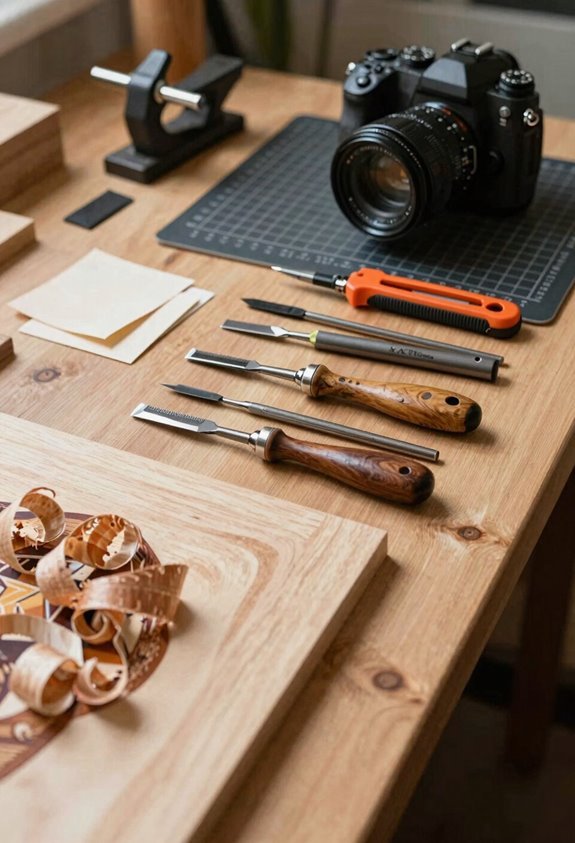
What separates a frustrating intarsia project from a smooth one? Having the right tools. You’ll want a scroll saw or band saw, your primary cutting tool for precision pieces. I can’t stress enough how important quality matters here.
For shaping, grab a belt sander, drum sander, and palm sander. These smooth your wood pieces into the contoured shapes intarsia requires. A Dremel drum sander handles detailed work beautifully.
Don’t forget your cutting essentials: keep extra blades handy, especially for dense woods that dull blades quickly. A zero-clearance jig prevents tearout on small pieces. It’s worth the investment.
For finishing, use fast-drying water-based polyurethane. It protects your work without yellowing. Start with these basics, and you’re ready to begin.
Cut and Fit Each Piece (Troubleshoot Gaps and Misalignment)
I’ll walk you through keeping your blade perfectly aligned and fixing those pesky gaps that pop up during assembly. Getting your saw blade positioned correctly, perpendicular to your wood and moving smoothly through your pattern, is important for pieces that fit like a puzzle instead of leaving annoying spaces.
Once you’ve cut everything, I’ll show you how to adjust pieces that don’t quite line up with your background, because even small gaps can ruin an otherwise beautiful intarsia design.
Blade Alignment And Positioning
Why do some intarsia pieces fit together like puzzle pieces while others leave frustrating gaps? The answer often lies in your blade alignment.
I’ve learned that proper blade positioning is important:
- Keep the blade perpendicular to your saw table; even slight angles create misaligned edges
- Choose the right blade type for your wood thickness to prevent drift and wandering cuts
- Check blade alignment regularly before starting each project, not just once
- Cut consistently along your marked line, whether inner or outer edge, maintaining steady pressure
When your blade sits square to the table, your pieces fit flush. I always verify alignment with a simple square before cutting. This single step eliminates most joint gaps before they happen, saving you from tedious re-cutting later. Your intarsia will thank you.
Gap Resolution And Adjustment
Even with perfect blade alignment, you’ll sometimes find small gaps between your fitted pieces, and that’s normal. I’ve learned that gaps happen to everyone, and they’re fixable.
Start by dry-fitting adjacent pieces on your master pattern. Check for misalignment, then adjust by re-cutting both pieces or repositioning them. I use a caliper to verify thickness matches across joints; this prevents hidden problems later.
For actual gap closure, I sand progressively: 60-grit roughens mating surfaces, then 100, 150, and 220 grit finishes them smooth. A 1/2″ sanding drum helps contour surfaces evenly.
If gaps persist after sanding, I re-glue and re-clamp the section, then re-sand once dry for flush joints and perfect seam alignment.
Shape and Sand Your Pieces for Dimensional Depth
How do flat wood pieces become a lifelike scene that seems to pop right off the wall? The answer lies in strategic sanding and shaping. I use specific equipment to create contours that make each piece blend smoothly with its neighbors, building that three-dimensional effect you’re after.
Here’s my sanding progression:
- Start with rough grits (60) using a 3×18″ belt sander for initial shaping
- Move to medium grits, employing a 1/2″ drum sander for contouring
- Progress to finer grits (220) for smooth, integrated surfaces
- Use small sanding drums to bring all pieces to equal thickness
I maintain piece-to-piece fit by re-cutting when necessary and using setbacks, like nose projection, to emphasize dimensionality. Once shaped, I’ll add a backer panel behind assembled pieces, then apply finish over it for added depth and stability.
Glue and Clamp Your Pieces to the Backing Board
At this stage, you’re ready to lock everything together. Getting the assembly right is important between a piece that holds strong and one that warps or splits down the road.
Before you glue the project, check that all pieces match thickness precisely. This prevents gaps that’ll ruin your finished look. Apply polyurethane to your backer panel first; it seals the wood and reduces warping.
When you’re ready, position each piece on the backing board using removable adhesive or spray adhesive. Align everything to your traced marks carefully. Once satisfied, glue the project by replacing temporary adhesive with permanent wood glue.
Clamp everything firmly and let it cure fully. Patience here pays off. Sand away any glue squeeze-out lightly. You’ve just completed the critical assembly phase that holds your intarsia together.
Finish Your Intarsia With Oil, Varnish, or Polyurethane
Once your glued-up intarsia sits secure and the clamps come off, you’re ready for the final step that’ll really make those wood colors stand out: finishing.
I recommend fast-drying water-based polyurethane. It’s your best option for highlighting the natural beauty of your wood pieces. Here’s what I do:
- Apply multiple thin coats, sanding lightly between each one for smoothness and adhesion
- Choose satin sheen over high-gloss to reduce glare and keep that authentic wood look
- Wipe on polyurethane with a cloth for even coverage without brushstrokes
- Clean all edges and contact surfaces of glue residue before finishing
The sanding between coats takes patience, but it’s worth it. You’ll end up with a durable, professional-looking finish that showcases your careful intarsia work beautifully.
Avoid Common Fitting and Glue-Up Pitfalls
You’ll want to nail three critical areas before your intarsia pieces come together: getting your cuts precise enough that parts fit like puzzle pieces, choosing the right glue and applying it without creating messy squeeze-out, and keeping everything aligned to your master pattern so nothing shifts.
Take time now on precision and cutting pieces to exact thickness, using those 1/4″ and 3/8″ references as guides. Check your joints early; catching a misfit before you’ve glued everything down beats hunting for problems later. Think of this stage as your quality-control checkpoint.
When you invest time upfront in accuracy and alignment, your final assembly will practically snap together.
Precision Cutting and Fit
Getting your intarsia pieces to fit together smoothly is where the real craftsmanship happens. I’ve learned that precision cutting makes everything easier down the line.
Here’s my approach to nailing the fit:
- Cut pieces slightly oversized, then carefully shape and contour them until they meet flush with neighbors
- Test-fit each piece against its adjacent pieces before applying any glue
- Use a zero-clearance jig and pilot holes when cutting small parts to reduce tear-out
- Re-cut both pieces if a joint doesn’t fit perfectly; don’t force it
I always match piece thickness by contouring everything to equal depth using a 3/4″ backing panel. If something isn’t quite right after test assembly, I grab my sanding drums or spindle sander to adjust.
This attention to detail will significantly improve your intarsia project, making it look like professional work rather than something amateur.
Glue Selection and Application
Now that your pieces fit together like a puzzle, the glue-up itself becomes your next challenge. I won’t sugarcoat it; this is where many intarsia projects either succeed or fail.
Choose Your Adhesive Wisely
I recommend woodworkers glue or repositionable adhesive. These options give you working time and let you reposition pieces if needed. Repositionable adhesive is especially handy because you can remove pattern copies without damage.
Execute Your Glue-Up Strategy
Here’s what I do: organize pieces by color or wood type before applying adhesive. This prevents mix-ups. Apply glue systematically, maintaining correct orientation throughout.
Use consistent clamping pressure across all joints. You’re aiming for even contact without excessive squeeze-out. Align pieces along grain direction. This strengthens your final assembly considerably and helps your intarsia work hold together for years.
Pattern Alignment and Assembly
The difference between a tight, seamless intarsia design and one with visible gaps comes down to how carefully I manage my patterns and pieces during assembly.
I keep two pattern copies: one stays glued to the wood as my cutting guide, while the second helps me reference piece placement. I number or color-code each piece to prevent confusion during glue-up, then check fit incrementally before committing to adhesive.
Here’s my assembly approach:
- Attach patterns with removable spray adhesive for easy repositioning
- Place neighboring pieces together to verify joints seat flush
- Use backer panels slightly thinner than your figure to maintain stability
- Re-cut misaligned pieces rather than forcing them together
This pattern alignment process takes patience, but it’s what creates the difference between professional results and frustrating gaps.
Showcase Your Intarsia Masterpiece
After weeks of careful planning, cutting, and assembly, your intarsia piece deserves a presentation that does justice to all that detailed work. I’d recommend displaying your creation in a shallow frame with satin polyurethane finish, which is a protective coating that highlights the depth you’ve created through contouring.
Choose contrasting frame moulding, like walnut with holly accents, to enhance that 3-D effect without overpowering your wood tones.
Photograph your intarsia from multiple angles under even lighting to capture the dimensional layers and wood grain choices. Include a brief materials list noting your 13-wood mix and thickness variations. Share your process too; layout, cutting sequence, and sanding steps educate viewers about achieving similar effects. This documentation helps turn your finished piece into an inspiring learning tool for fellow woodworkers.