I’ve spent years watching people overlook extraordinary value in dusty tool boxes. Here’s the thing: your old chisel or plane might be worth hundreds or thousands if you know what collectors actually want.
Seven specific factors separate a worthless relic from a treasure. Let me show you exactly what those factors are and how to spot them in your own tools.
Condition and Originality: Why Pristine Woodworking Tools Command Premium Prices
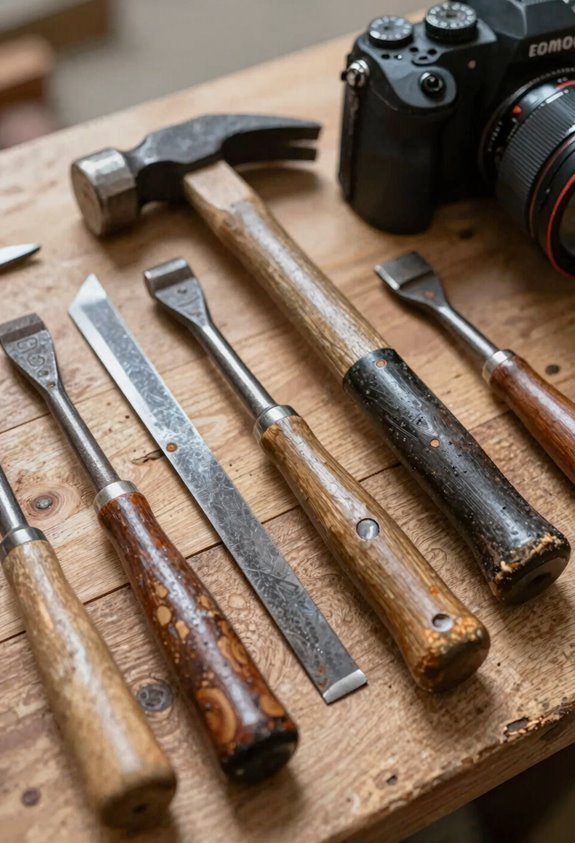
Why do some old chisels sell for hundreds of dollars while others gather dust at estate sales? The answer lies in condition and originality. I’ve noticed that pristine finishes, unmarred handles, unblemished metal, signal rarity and authenticity to collectors like us. Original components matter tremendously. An unaltered blade, untouched nuts, and factory fittings preserve what makes a tool valuable.
Pristine finishes and original components signal authenticity to collectors—what truly separates valuable heirlooms from worthless tools.
Here’s what impacts price most:
- Minimal wear indicates true age and careful storage
- Unmodified parts prove the tool’s authentic history
- Consistent patina (the natural aging layer) actually enhances appeal when earned honestly
Professionally restored tools retain more value than poorly cleaned ones. Think of it this way: collectors pay premium prices because pristine condition tells a tool’s genuine story. That’s what separates heirlooms from junk.
Rarity and Historical Significance: What Collectors Actually Seek
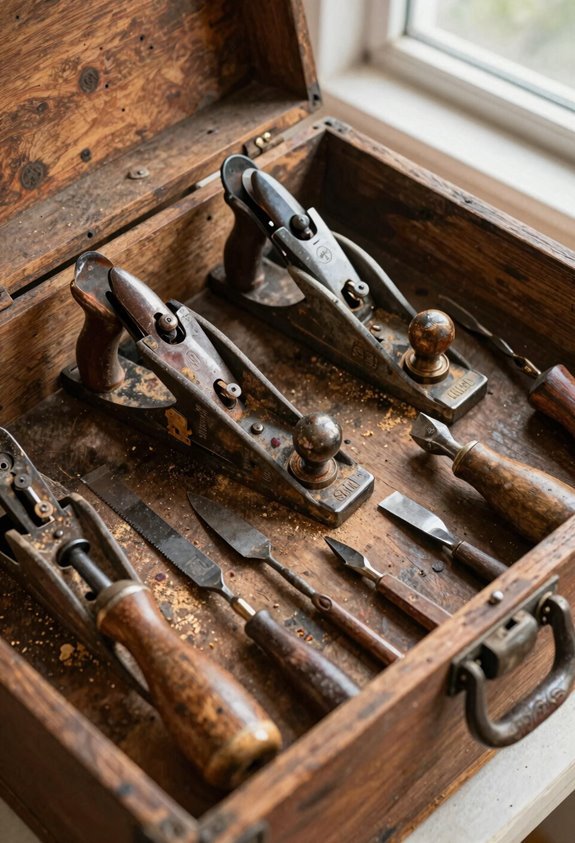
When you’re hunting for valuable old woodworking tools, you’ll notice that rarity, meaning how few examples still exist, can make or break a tool’s worth at auction. Tools from limited production runs, especially those with documented provenance (basically, a verified paper trail showing who owned it and when), command notably higher prices because collectors can’t easily find alternatives.
For instance, a Norris plane from the 1880s with original paperwork proving its maker and previous owners might fetch thousands, while an unmarked generic plane from the same era sells for under fifty dollars.
Limited Production Runs Matter
Because fewer tools were made, collectors’ll pay more for items that’re genuinely hard to find. When a maker produced limited production runs, say only a handful of infill planes in a single year, those rare pieces become treasure. You’re looking at tools that command appreciably higher auction prices than mass-produced versions.
Here’s why scarcity matters: Early Norris planes or pre-war Stanley models weren’t churned out by the thousands. Each limited run represents a specific moment in toolmaking history.
When you own something from a short-lived production period, you’re holding a documented piece of craftsmanship. The connection between restricted output and value is straightforward: fewer tools exist, more collectors want them, and prices climb. That’s the collectors’ logic, and it drives real market demand for these exceptional, hard-to-find pieces.
Documented Provenance Enhances Value
While scarcity alone makes a tool valuable, you can push that value even higher when you’ve got solid proof of where a tool came from and who owned it. I’m talking about documented provenance: the paper trail that proves authenticity.
Here’s what collectors seek: maker marks stamped into steel, serial numbers matching factory records, and clear ownership histories. When you can trace a chisel back to a specific woodshop or famous craftsperson, suddenly that tool tells a story worth real money.
Think of provenance as your tool’s resume. A plane with verified lineage to a notable workshop commands stronger bidder interest at auction than an identical unmarked version. That documented backstory justifies premium pricing because collectors aren’t just buying craftsmanship; they’re buying history and belonging to an exclusive community.
Stanley, Norris, and Other Makers Worth the Premium
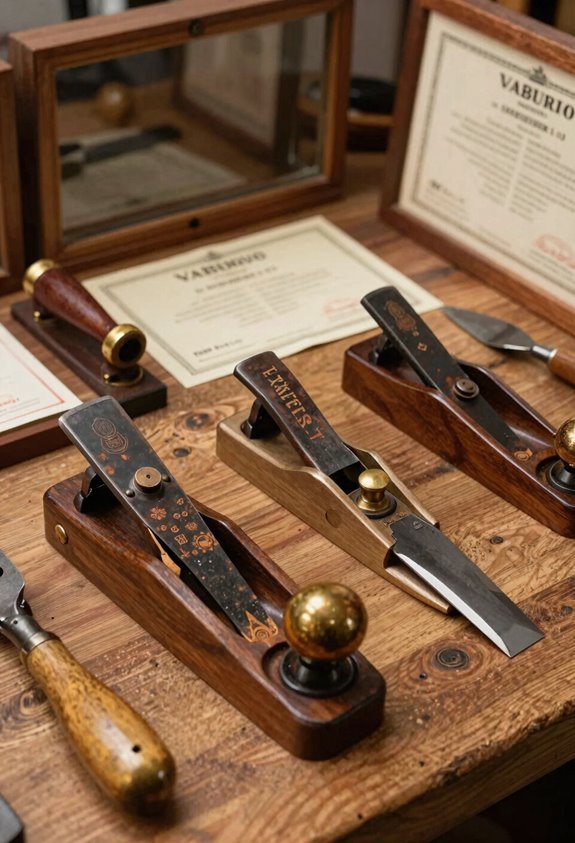
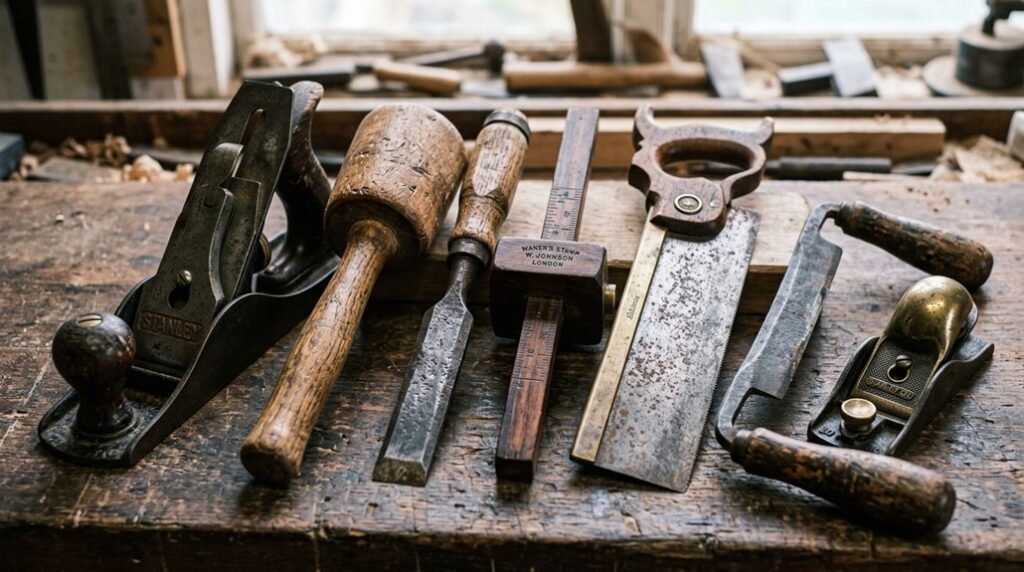
Certain tool manufacturers have built reputations so solid that their names alone can shift a tool’s value upward, sometimes dramatically. Stanley tools command collector attention because they’ve consistently delivered quality across decades. Early Stanley planes and their No. 98 Level items regularly outperform expectations at auction.
Then there’s Norris planes: the premium choice of serious woodworkers historically. Some Norris models, particularly those featuring the 1913 micrometre-style adjuster, sell for thousands when condition’s excellent.
What makes these makers different? Brand reputation matters enormously. A Stanley or Norris tool tells collectors you’re holding something vetted by time and professional use. That maker’s mark isn’t just a name; it’s a quality guarantee that makes an ordinary hand plane into a sought-after investment piece worth serious money.
Tracing Your Tool’s Age and Ownership
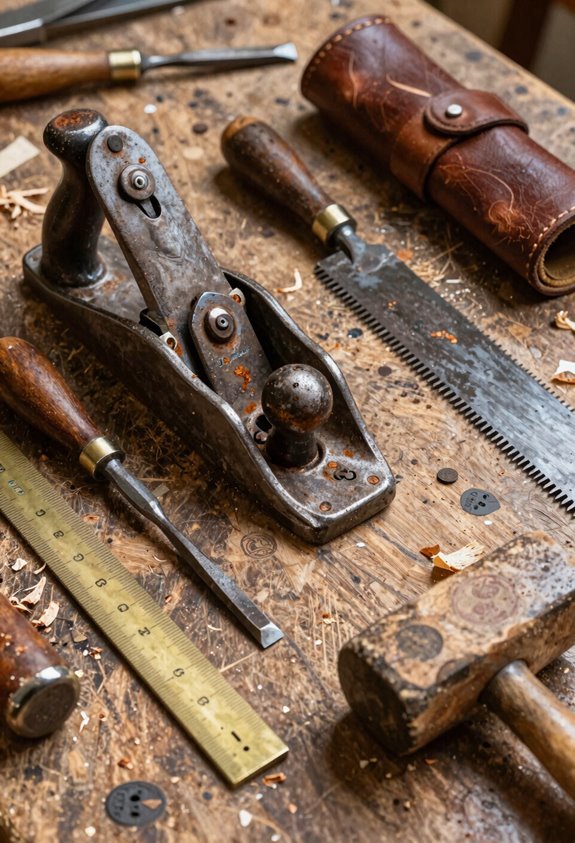
How can you tell if that dusty plane you found at a flea market is actually worth something?
Start by examining maker’s marks—those stamps or signatures that identify who crafted your tool. They’re your golden ticket to authentication. Next, determine the tool’s age. Pre-1900 tools typically command higher prices than newer versions, so look for period-specific manufacturing techniques and materials.
Track down ownership history if possible. Here’s what I recommend investigating:
- Check for original hardware, handles, and finishes that haven’t been replaced
- Research the maker’s production dates through collector guides
- Document any famous previous owners or provenance
- Photograph maker’s marks clearly from multiple angles
These detective steps help you understand what you’ve actually got. The combination of age, authentic maker’s marks, and documented history makes an ordinary find into something valuable.
The Craftsmanship and Materials That Drive Value
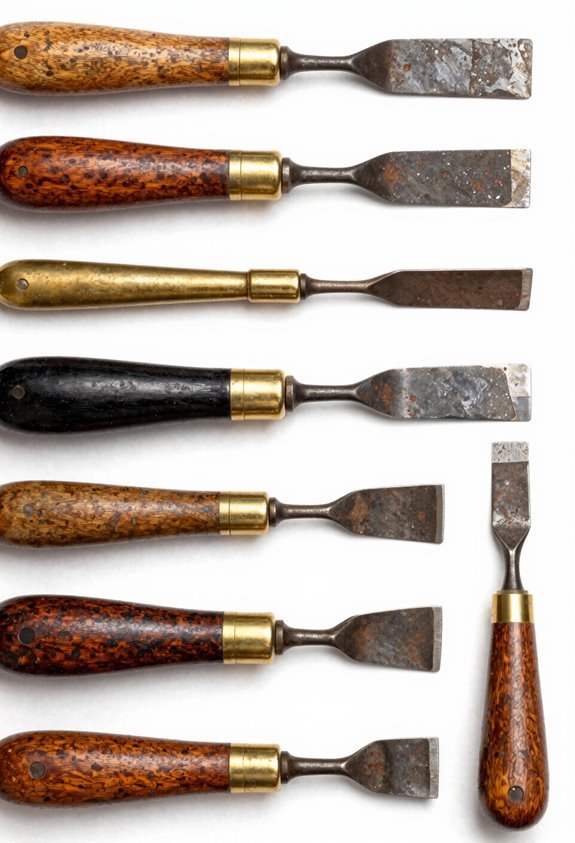
When you’re evaluating an old woodworking tool, you’ll quickly notice that how it’s made and what it’s built from matter just as much as its age. I’m going to walk you through three key areas: the handmade construction that proves authenticity, the premium materials that catch collectors’ eyes, and the artistic design elements that push prices higher.
Understanding these factors helps you spot why one vintage plane might sell for $50 while another fetches $500.
Handmade Construction and Heritage
Because master craftspeople invested hours of skilled labor into each tool, handmade woodworking tools command respect and higher prices in today’s collector market. You’ll notice the difference immediately when you examine authentic pieces.
Signs of Authentic Handmade Construction:
- Visible file marks and plane iron sharpening patterns that show individual craftsmanship
- Intricate joinery and bespoke fittings unique to each tool
- Exotic woods, early steels, and brass components indicating quality materials
- Maker reputation tied to notable workshops or historical periods
Heritage matters tremendously. When you own a tool connected to a respected craftsperson or significant era, you’re holding more than an object; you’re preserving woodworking history.
These tools age gracefully, maintaining functional integrity across generations. That durability and authenticity translate directly to auction value and collector demand.
Premium Materials and Quality
Most valuable antique woodworking tools share one thing in common: they’re built from materials that simply don’t get used much anymore. I’ve noticed that Brazilian rosewood, ebony, and brass fittings consistently boost a tool’s desirability and market value. When you examine these pieces closely, you’ll spot intricate carvings and inlays that signal superior craftsmanship, the kind that takes real skill to create.
What really matters to collectors like us is authenticity. Original components and minimal substitutions preserve a tool’s investment potential. Look for maker marks from reputable brands like Norris or Stanley; these stamps confirm origin and age, adding credibility.
Tools with well-preserved original finishes command higher prices than worn equivalents. That’s because premium materials combined with quality construction represent something increasingly rare: genuine craftsmanship that endured decades of use.
Artistic Design and Rarity
Why do two seemingly similar chisels sell for vastly different prices at auction? The answer lies in artistic design and rarity, two powerful value drivers that separate ordinary antique tools from treasured collectibles.
I’ve found that distinctive design significantly increases a tool’s appeal. When you’re hunting for antique tools, here’s what catches collectors’ eyes:
- Intricate carving on handles or blades that showcase craftsmanship
- Limited production runs that make certain models scarce
- Signature design elements from recognized makers or brands
- Notable inlays using contrasting materials that signal quality
Rarity compounds this effect. A Norris plane with special edition markings? That’s valuable. A chisel with unique brass binding? Collectors compete for it.
The scarcity factor makes a functional tool into a prized possession. When supply is low and desirability is high, value climbs dramatically.
Complete Sets and Working Condition
If you’ve ever found a single tool at a flea market and wondered why it wasn’t worth much, here’s the answer: collectors will pay considerably more for complete sets than for individual pieces. I’ve seen a lone chisel sell for $15, while an identical complete set with its original box fetched $150. That’s the power of completeness.
Working condition matters too. A plane that still cuts smoothly adds real value, proving the tool’s functional integrity. However, I’d caution against over-restoring; collectors actually prefer original patina and minor wear that shows authentic history.
Missing essential components like handles or blades significantly tank a tool’s desirability. The key is to keep pieces together, store them properly, and document their original condition. That’s how you maximize value.
What the Market Pays Today
Now that you understand how completeness and condition drive value, you’re probably wondering what your finds might actually be worth. I’ll break down today’s market reality for you.
Here’s what collectors typically pay:
- Common vintage tools: £20–£100 at auction
- Hand planes (standard models): £50–£500 depending on maker
- Rare hand planes (Norris or early Stanley): £2,000–£15,000
- Vintage saws: £160–£240 on average
The difference between a £30 tool and a £3,000 one comes down to maker reputation, originality, and rarity. A pristine Stanley No. 4 with its box commands serious money. Meanwhile, a generic unmarked plane might struggle to break £50.
Your research matters. Check recent sales, compare conditions honestly, and you’ll understand your collection’s true worth.