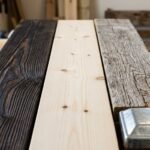
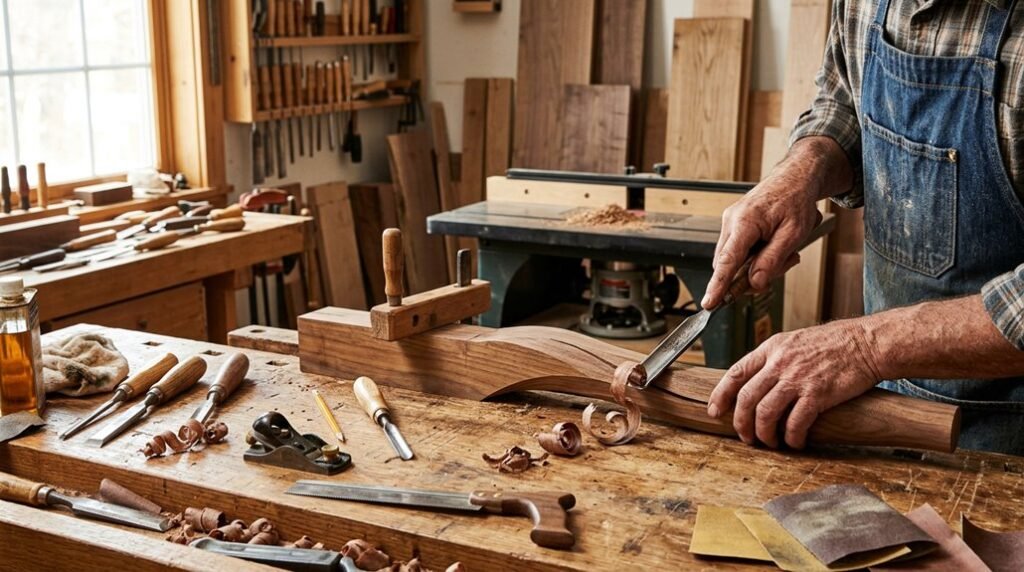
Woodworking is like building with a language; you’ve got to learn the alphabet before you write poetry. I’m here to guide you through the ten essential techniques that separate sloppy projects from furniture you’ll actually be proud of.
We’ll cover everything from measuring straight to finishing surfaces, but first, you need to understand why getting the basics right changes everything. Ready to discover what separates amateur work from craftsmanship?
Master Measuring, Marking, and Setup
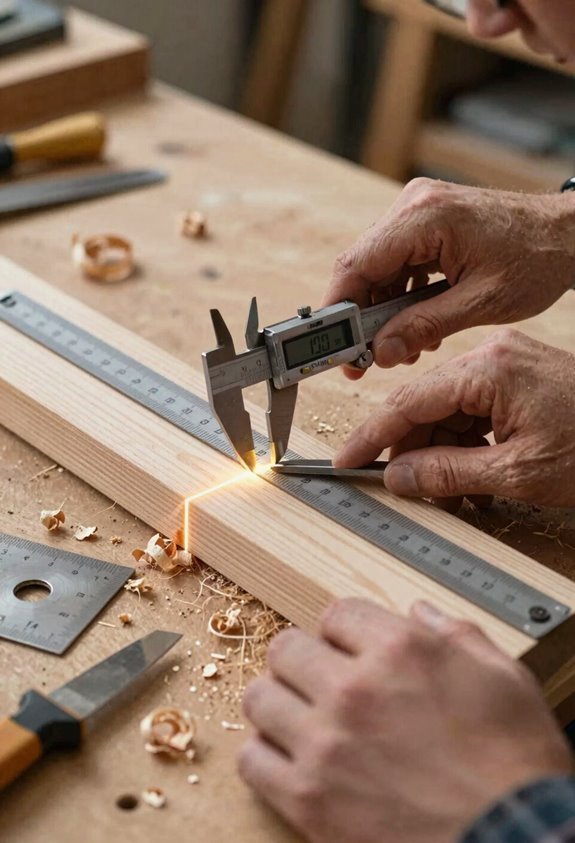
Before you even think about picking up a saw, you’ve got to get your measurements and markings right. Unlike a typo in homework, a cut in the wrong place can’t be erased.
Before you pick up a saw, get your measurements and markings right. A cut in the wrong place can’t be erased.
I start by measuring twice with sharp pencils and a combination square to verify squareness and edge alignment. Clear marking matters too. I choose pencils or marking knives that show up against my wood’s color, considering how wide my saw blade is so the line stays visible during cutting.
Next comes setup. I check that my workpiece sits flat and stable. I mark lines boldly, then use a combination square to confirm everything’s square before I make any cuts.
This foundation prevents frustration later. Accurate measuring, precise marking, and careful setup guarantee my cuts land exactly where I intend them to.
Safety First: Eye, Ear, and Hand Protection
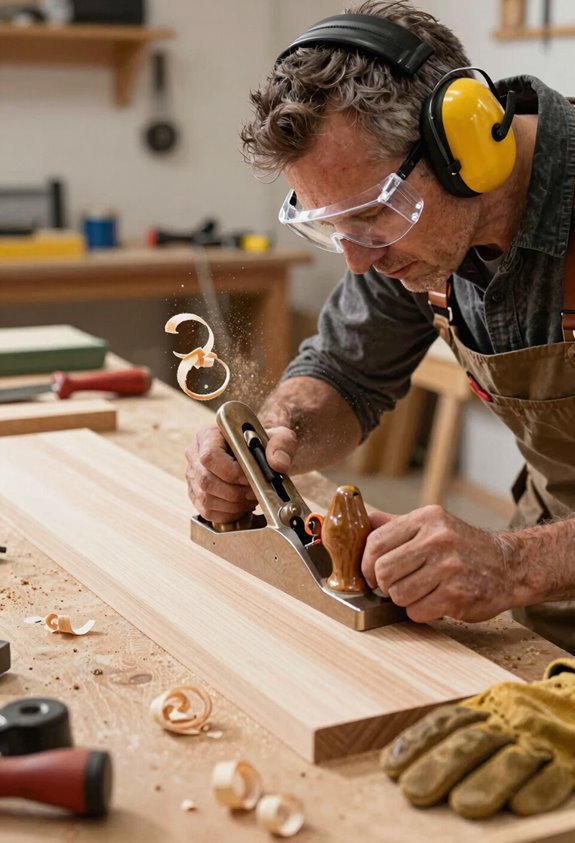
Why do so many woodworkers wear safety gear that makes them look like they’re heading into battle? Because we’re protecting ourselves from real hazards. I’ve learned that safety glasses shield my eyes from flying chips and dust during cutting operations. Ear protection is crucial when I’m running loud power tools; consistent noise exposure causes permanent hearing damage over time.
For hand protection, I wear gloves when appropriate, though I balance this with maintaining tactile feel for better control. I’ve discovered that sharp tools reduce slip hazards significantly and improve my precision. Understanding machine safeguards prevents accidents like kickback on saws or bit binding during routing. These protections aren’t optional extras; they’re how I stay injury-free while mastering my craft.
Milling: Flattening Rough Lumber Into Blanks
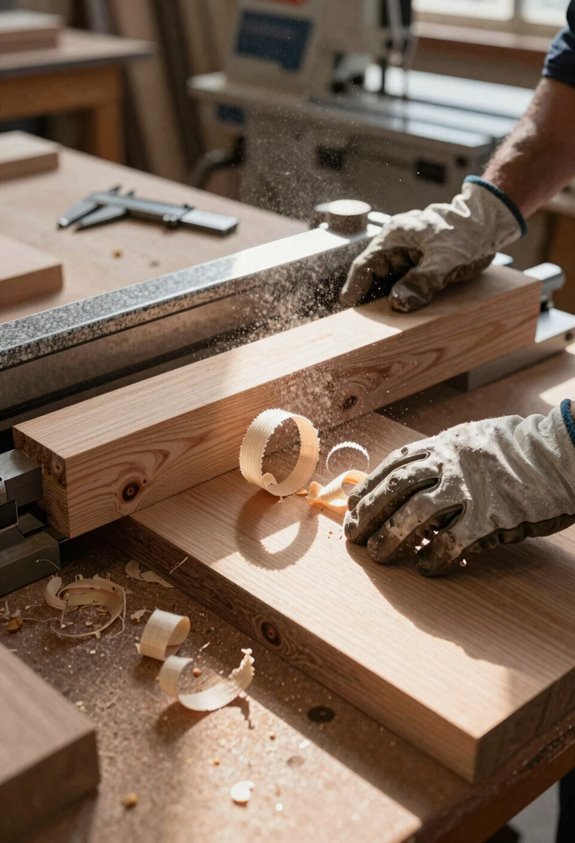
Now that you’ve got your safety gear on, it’s time to learn milling, the process that converts rough, warped lumber into perfectly flat, square blanks ready for joinery. I’ll start you with the jointer, a machine that flattens your first face and establishes the reference edge you’ll need, then move to the planer, which mirrors that flatness on the opposite side to create uniform thickness.
Finally, you’ll use the table saw to rip the last edge parallel to your first flat face, giving you a squared board that’s the solid foundation for everything that comes next.
Jointer Face Flattening
How do you turn a warped, rough board into something flat enough for quality furniture? You’ll start with the jointer, a machine that creates your first flat surface called the reference surface.
Here’s what happens in this process:
- Feed the board’s worst face across the jointer’s cutting knives
- Make multiple passes until you’ve got one completely flat face
- Flip the board over and plane the opposite face parallel to it
- This establishes parallel faces, your foundation for everything ahead
Once you’ve got these two flat, parallel faces, you’re ready to rip edges on the table saw with confidence. They’ll run perfectly parallel because you’ve created that reference surface.
This is where precision begins. You’re not just flattening wood; you’re preparing blanks that’ll accept joinery perfectly and fit together smoothly.
Planer And Edge Work
Once you’ve created that first flat face on the jointer, you’re ready for the next critical step: getting the rest of your board perfectly flat and parallel.
The planer’s your new best friend. It removes material from the opposite face, creating two perfectly parallel surfaces. This uniformity is what separates rough lumber from milling-ready blanks.
Here’s the workflow:
Planer work: Feed your jointer-flattened face against the planer bed. Make multiple passes, removing thin layers each time (think 1/8 inch per pass).
Edge work: After planing, use your jointer to flatten one edge, then the table saw to rip the final edge parallel. You’ve now got four square, flat faces ready for accurate joinery.
This preparation gives your rough stock the consistency and stability needed for reliable blanks.
Preparation For Accurate Joinery
Why does milling matter so much before you ever touch a router or saw to your final project? Because rough lumber won’t cooperate with precision work. I’ve learned that milling, the process of flattening rough blanks into dimensionally stable stock, is your foundation for everything that follows.
Here’s the sequence I follow:
- Joint one face flat on the jointer, creating your reference surface
- Plane the opposite face parallel, producing two flat, parallel faces
- Rip one edge square and parallel using the table saw
- Thickness and flatten remaining surfaces for consistency
This flattening and thickening process keeps your stock parallel throughout. When I prepare blanks this way, my joinery fits perfectly because everything’s square and true. Accurate preparation means accurate results.
Planing and Jointing for Flat, Smooth Surfaces
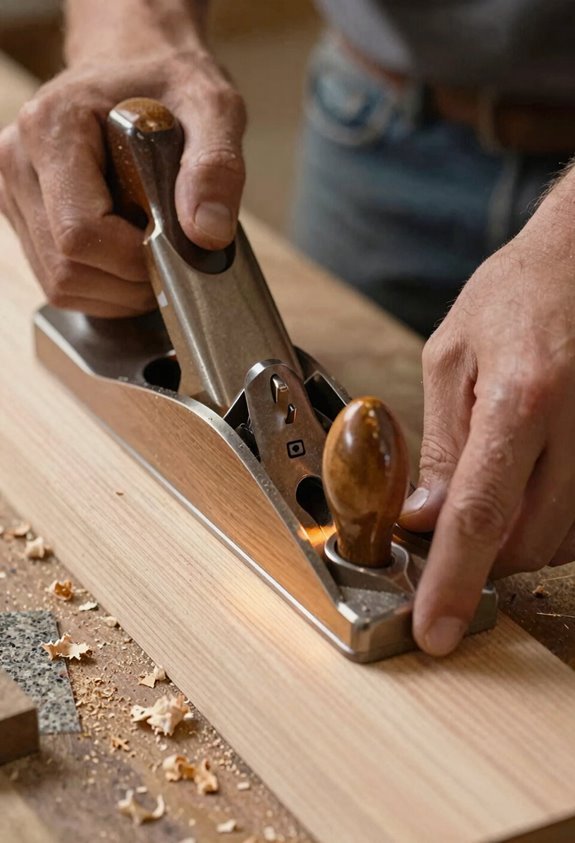
What’s the difference between a warped board and one that’s perfectly flat? Everything. I’ll walk you through planing and jointing, two essential techniques that create rough lumber into workpieces ready for accurate joinery.
Jointing comes first. I flatten one face, establishing a reference surface. Then I square one edge against that face. These reference surfaces guide all subsequent operations.
Planing follows. I remove material from opposite surfaces, creating consistent thickness and smooth finishes. Hand planes give me precision for fine details; electric planers handle larger areas faster.
| Tool Type | Best Use | Speed | Precision |
|---|---|---|---|
| Hand plane | Detail work | Slow | High |
| Electric planer | Large surfaces | Fast | Good |
| Jointer | Reference faces | Medium | Very high |
| Thickness planer | Uniform thickness | Fast | Excellent |
| Combination | Versatility | Variable | Good |
Proper surface preparation produces flat, straight, square results every time.
Sawing Straight and True
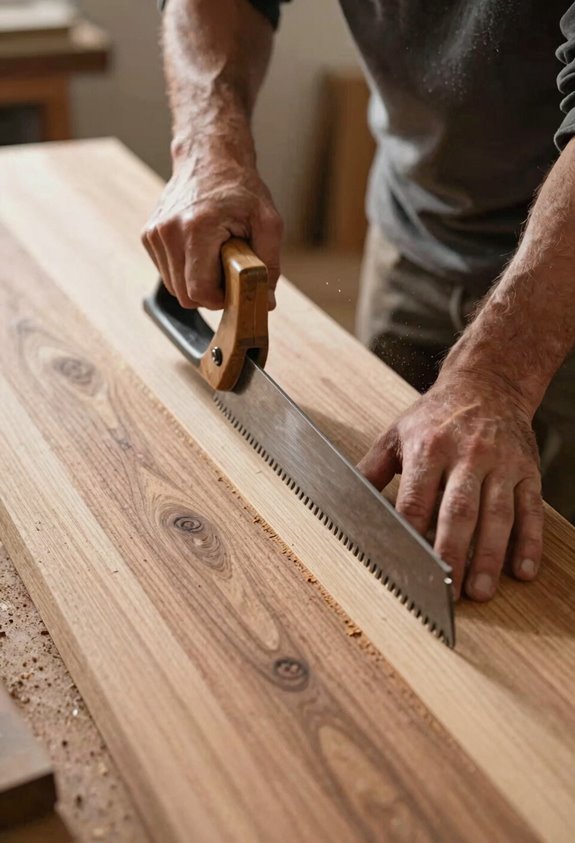
When you’re ready to make a cut that doesn’t wander across your wood like a wobbly bicycle, I’ll show you how marking and setup accuracy become your best friends. Think of them as the difference between drawing a straight line freehand and using a ruler.
You’ll need to control your blade with deliberate technique, maintaining steady forward-and-backward motions that keep everything aligned rather than rushed, which prevents splintering and misalignment where it matters most. The real trick is learning how to prevent wandering and splintering by using grooves as guides and tilting your saw back slightly on the final pass for that clean, true finish you’re after.
Marking and Setup Accuracy
How do you make a cut that’s actually straight? The secret lies in setup. I’ll walk you through the essentials for marking lines and cutting alignment that’ll improve your accuracy.
- Mark with arrow indicators showing which side you’re cutting, preventing confusion mid-cut
- Account for blade width in your line-marking to maintain true right-angled cuts and square ends
- Create three guide grooves for the saw to follow, starting with a notch for alignment
- Align adjacent sides in sequence to improve overall squareness across your workpiece
Before sawing, I establish cutting alignment by taking time with my marking lines. Blade width accounting matters because saws remove material, about an eighth-inch typically.
When I respect these details, my squareness improves dramatically, and the wood cooperates better throughout each cut.
Blade Control and Technique
Once you’ve marked your line and set up your cut, the real skill kicks in—actually controlling the saw to follow that line without wandering. I start with a notch and use a back-and-forth motion, avoiding downward push to maintain control. Here’s my approach: I create three guiding grooves that keep my blade aligned for straight cuts. This guided cuts method gives you precision instead of guesswork.
As I cut through, I maintain consistent rhythm and pressure. Near the end, I tilt the saw back slightly to minimize tear-out and surface damage. These blade control techniques work together to produce better results.
When you combine solid marking accuracy with controlled technique, you’ll consistently achieve square ends that fit together perfectly.
Preventing Wandering and Splintering
Why do some cuts veer off course while others stay perfectly aligned? The secret lies in preventing wandering and splintering through deliberate technique.
I’ve found these strategies essential for straight cuts:
- Create three guide grooves before cutting deep; they’ll keep your blade honest
- Mark lines with precision, considering blade width versus marking accuracy
- Use controlled motion with steady back-and-forth strokes along the grooves
- Slow down near the finish, tilting your saw back to minimize splintering
The grooves act like train tracks for your blade. When you maintain consistent pressure and follow them faithfully, wandering becomes nearly impossible.
Start shallow, let the tool do the work, and resist rushing. That patience results in clean, professional-looking straight cuts you’ll feel proud of.
Drilling, Boring, and Hole Placement
Precise holes are the foundation of strong woodworking joints, and mastering drilling and boring—two distinct techniques—will improve your projects. Drilling creates new holes, while boring enlarges existing ones. You’ll use different drill bits for different jobs, and selecting the right tool matters.
| Bit Type | Purpose | Best For |
|---|---|---|
| Twist bits | General-purpose holes | Standard drilling tasks |
| Forstner bits | Flat-bottomed holes | Dowels and hinges |
| Spade bits | Larger exploratory holes | Quick, rough work |
I recommend using a drill press for stationary control or a handheld driver for flexibility. Mark your hole placement carefully so joints fit correctly. Back your workpiece to prevent tear-out, and back out occasionally to cool the bit and clear chips away.
Routing for Edges and Details
You’ll find that a router, whether you’re holding it in your hands or mounting it under a table, becomes one of your most flexible woodworking partners once you master bit selection and positioning. The bit you choose determines everything from the profile shape, like roundovers or decorative edges, to the depth and width of cuts, so picking the right one for your project is half the battle.
I recommend starting with handheld routing for smaller decorative work and edge treatments, then progressing to table-mounted setups when you’re ready to tackle larger pieces or need more precision and stability.
Versatile Bit Selection Options
How do you transform a plain wooden edge into something that catches the eye? The answer lies in choosing the right router bits. I’ve discovered that bit selection is what separates basic work from eye-catching finishes.
Here’s what you’ll encounter when exploring router versatility:
- Decorative bits – Create profiles like roundovers and ogees for refined edges
- Joinery groove bits – Cut precise slots for joining boards together seamlessly
- Dado bits – Form wide, flat-bottomed grooves for shelving and structural support
- Edge treatment bits – Shape rabbets and chamfers for finished appearances
Each bit type delivers different results. A roundover bit gives warmth to an edge, while a core box bit carves decorative grooves.
I’ve found that investing in quality bits pays off through cleaner cuts and longer tool life. Your edge treatments and joinery become repeatable and professional-looking every time.
Handheld Versus Table Mounting
When should you grab your router by the handles instead of mounting it underneath a table? I’d choose handheld routing when you’re working on irregular shapes or need quick adjustments. It’s flexible and lets you move freely around your piece.
Table-mounted routing, though, is your go-to for precision work. Since the router stays stationary and you guide the wood through it, you’ll get straighter lines and cleaner corners. Your work-holding setup becomes stable, which means repeatable results every time.
Think of handheld routing like freehand drawing; it’s creative but variable. Table-mounted routing is like using a ruler. For edge bits and detailed profiles, the table method delivers superior dimensional accuracy. Choose based on your project’s demands.
Gluing and Clamping Tight Joints
Why do some woodworking joints hold strong for decades while others fail within months? The answer lies in mastering gluing and clamping, two skills that will create durable projects.
Here’s what I’ve learned works best:
- Prepare surfaces properly: sand and clean wood before applying glue
- Choose the right adhesive: interior white/yellow glue for indoor projects, exterior epoxy for outdoor durability
- Apply consistent clamping pressure: use bar clamps, pipe clamps, or F-clamps to distribute force evenly
- Honor drying time: patience prevents weak joints; follow manufacturer guidelines carefully
I can’t stress enough how important even pressure is across your joints. Uneven clamping creates stress points that’ll eventually crack.
When you respect the drying time and use appropriate clamps, you’re building pieces meant to last generations. That’s the real payoff here.
Sanding: From Tool Marks to Smooth
The difference between a rough, splintery surface and one that’s silky-smooth comes down to one thing: proper sanding.
I’ll guide you through this important finish prep stage. Start with coarser sandpaper grit (60–80) to remove tool marks, then progress to finer grits (220–320) for that polished feel. Always sand with the grain direction to avoid scratches that’ll show later.
For large surfaces, I recommend using a sanding block; it distributes pressure evenly and prevents gouges. Hand sanding works great for intricate areas where you need control.
Once you’ve achieved that smooth surface, you’re ready for stain or varnish. That final protective layer will really make your grain pop. You’ve earned it.
Finishing: Protecting and Enhancing Wood
Now that your wood’s smooth and ready, it’s time to protect it and bring out its best features. Finishing isn’t just about looks; it’s your defense against moisture, scratches, and the elements. I’ll walk you through the main finishing options so you can choose what works best for your project.
- Staining adds color while highlighting the wood’s natural grain
- Varnishing creates a durable clear coat with different sheens for indoor or outdoor use
- Waxing gives a soft finish that resists minor scratches
- Oil finishing (like tung oil) penetrates deeply for a warm, enhanced appearance
For outdoor protection, proper sealing matters most. Indoor pieces offer more flexibility. Each method delivers different moisture resistance levels, so consider your piece’s final location before choosing your finishing approach.