It’s funny how the most frustrating part of woodworking—making straight cuts—is also the easiest to fix. I’ve learned that building your own jigs improves your accuracy and speed dramatically without emptying your wallet.
Whether you’re working with a circular saw or router, the right jig becomes your best advantage. But here’s the thing: choosing which jig to build first matters more than you’d think, and it depends entirely on what tools you already own.
How Jigs Improve Accuracy and Speed
Why do woodworkers spend time building jigs when they could just grab their tools and start cutting? Because jigs help you join our community of precision craftspeople.
Jigs help you join our community of precision craftspeople by eliminating guesswork and producing consistent results.
I’ve discovered that jigs improve accuracy by providing repeatable references; think of them as guides that do the thinking for you. A track saw conversion with a zero-clearance edge keeps your base plate perfectly aligned every single time.
Speed increases dramatically too. My cross-cut sled handles 90-degree cuts with minimal repositioning. Router jigs let me tackle multiple operations without constantly switching setups.
Here’s what I’ve learned: jigs aren’t shortcuts. They’re investments. They eliminate guesswork, reduce mistakes, and let you produce consistent results batch after batch. Once you build your first jig, you’ll understand why experienced woodworkers never skip this step.
Choose Your First Jig Based on Your Tools
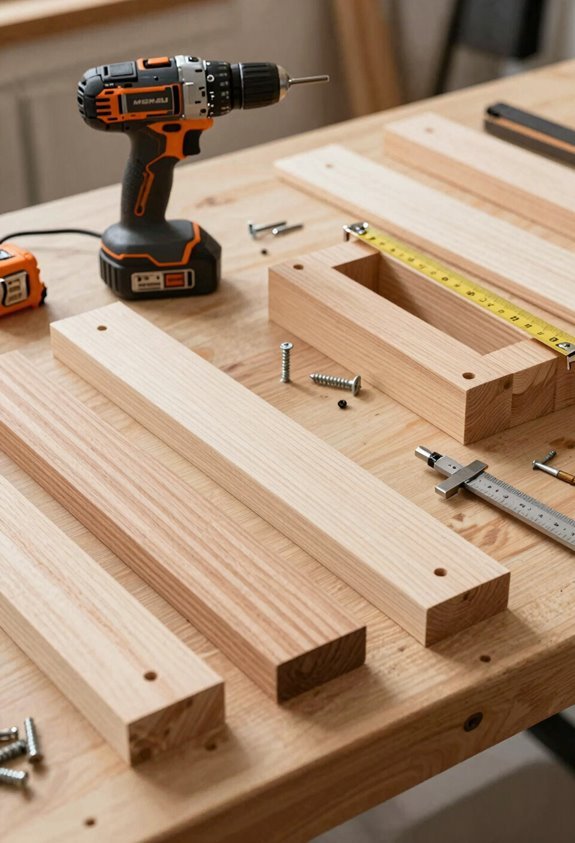
The jig you build first should match the tools you already own. There’s no point making something for equipment you don’t have.
Own a circular saw? Start with a simple cross-cutting jig using a straight guide and MDF base. You’ll get precise 90-degree cuts fast.
Want track saw results without the price tag? Build a track saw jig from scrap wood. It copies expensive equipment affordably.
Need safer ripping for narrow stock? A ripping jig with a 65 mm fence offset handles thin pieces you’d never safely push through a table saw.
Interested in routing? Consider a router table or jig thicknesser with zero-clearance edges and aluminum base plate for smooth, controlled cuts.
Match your jig to what’s in your workshop already.
Build Your First Jig: A Circular Saw Guide
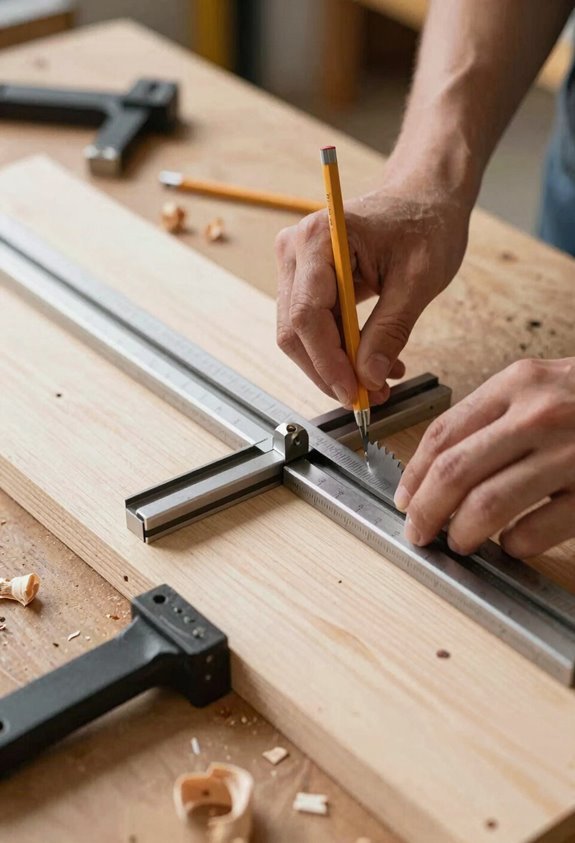
Now that you’ve picked a jig matching your tools, let’s build one: a circular saw guide. This straight-edge jig helps you make perpendicular cuts without drift or kickback.
You’ll need a plywood base (3/4″ thick works great) measuring about 48″ long and 2–3″ wide. Measure from your saw blade to where you want the guide edge, then screw a top piece slightly farther out. This offset handles your blade’s thickness.
When you’re ready to cut, clamp your jig firmly and slide the saw along that edge. Press your base against the fence alignment for accuracy, and slip scrap underneath for tear-out prevention. Remember your depth adjustment; account for the jig’s thickness so you don’t cut too deep.
Build a Track Saw Jig to Replace Expensive Straight-Edge Tools
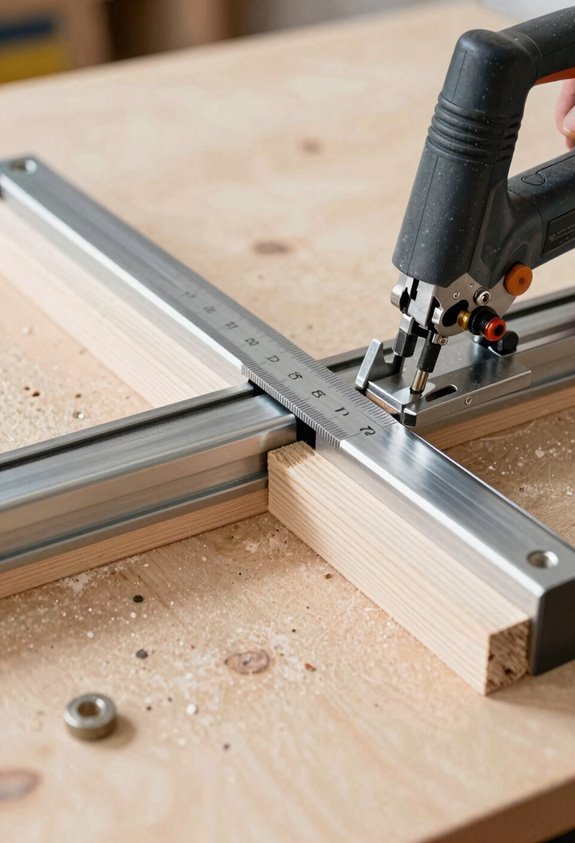
If you’ve priced out a commercial track saw lately, you’ll understand why building your own track saw jig makes sense; it’ll save you hundreds of dollars while giving you the same straight, clean cuts. I’ll show you how to create a straight-edge replacement that’ll handle plywood cutting like a pro.
Start with a 3–4 foot rail and a 10-inch-wide base tapering to 2–3 inches. Measure from your saw’s base plate edge to the blade, add ½ inch, then align your fence. Build a zero-clearance edge by gluing and screwing a second piece flush against the base plate.
Set your blade so teeth just peek under the jig. Clamp firmly, trace your line, and guide the saw steadily along the fence. You’ve built a router base guide that delivers precision cuts without the premium price tag.
Master Ripping Narrow Stock Safely Without a Table Saw
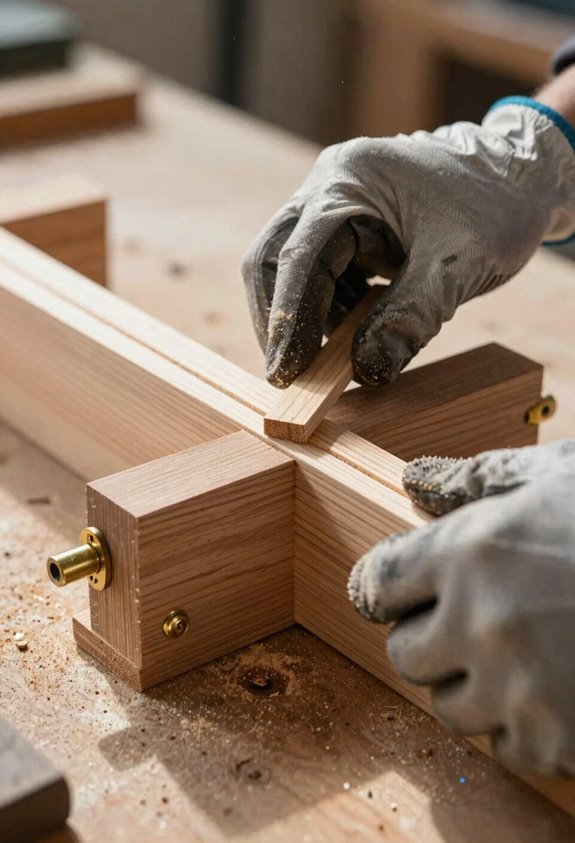
While that track saw jig handles crosscutting like a champ, you’ll run into trouble when you need to rip (cut lengthwise) thin pieces of wood, especially if you don’t have a table saw on hand.
Track saw jigs excel at crosscutting, but ripping thin stock without a table saw demands a different solution.
I’ve built a narrow stock ripping jig that solves this problem. Here’s what makes it work:
- Base foundation: Start with 25x125mm pallet wood, about 1 meter long
- Fence setup: Attach a 6mm thick fence perpendicular to the base, positioned 65mm from the edge to guide thin strips safely
- Adjustable stop: Mount a perpendicular stop at the fence end for consistent stock placement
- Blade depth control: Set your saw to cut just through the stock, never into the jig itself
Clamp everything securely, and you’ll rip narrow pieces with confidence. No table saw required.
Assemble a Router Table From Scrap Materials in an Afternoon
A router table improves your woodworking by letting you make consistent cuts without wrestling with a handheld router. I’ll show you how to build one from scrap materials in an afternoon.
Start by gathering 9mm or 3/8″ plywood, a router, drill, screws, and clamps. Use your router base as a template to mark hole positions, then drill them out with a Forstner bit. Flip your router upside down and attach it to the new top.
Next, build a straight fence with a recessed cavity over the router bit. Align your router bit with the fence to create a zero-clearance edge; this prevents tearout on your workpieces.
Clamp everything securely. Now you’ve got a jig that delivers straight cuts every time. Your scrap materials just became a useful tool.
Create a Router Sled Thicknesser for Consistent Stock Milling
Once you’ve mastered the router table, you’re ready for the next challenge: milling boards to exact thickness. A router sled thicknesser is your answer. I’ll walk you through building this essential jig that delivers stock uniformity across every board.
Here’s what makes this router guide work:
- Use a 12–19 mm plywood base with two 36 mm side runners for stability and stock access
- Mount aluminum angle pieces or wooden L-shaped tracks that ride smoothly along rails, keeping everything straight
- Clamp your stock securely to prevent movement during the milling process
- Adjust blade depth carefully, removing only your target amount per pass for consistent results
This jig turns uneven boards into perfectly matched pieces, making your woodworking projects look professional.