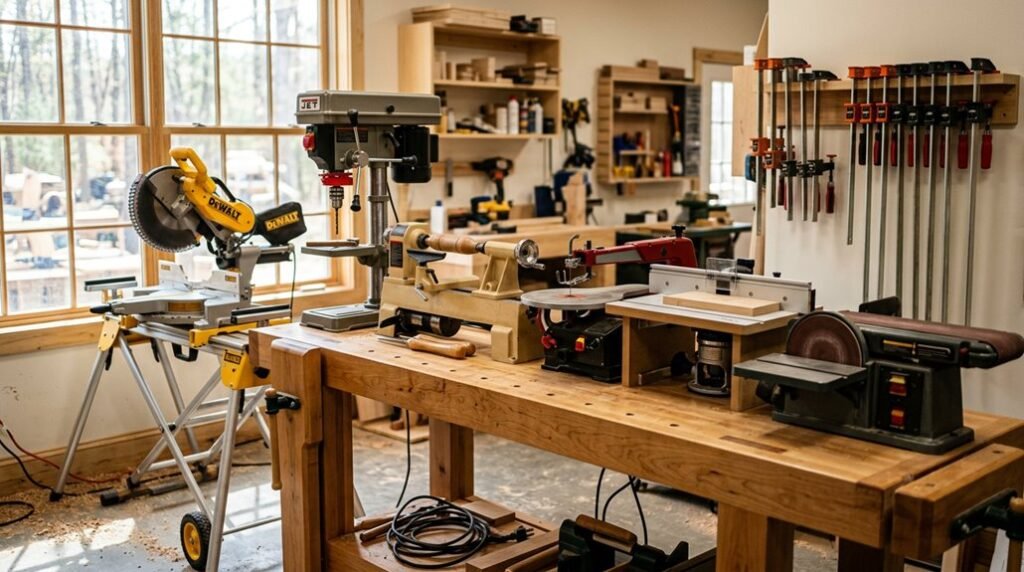
Studies show that woodworkers in tight spaces waste up to 40% of their time switching between tools or hunting for workspace. Here’s the thing: you don’t need a massive shop to create quality pieces.
I’ve found that seven carefully chosen tools, strategically selected for their versatility and compact footprint, can help you work more efficiently in your small workshop. But which seven actually matter most?
Table Saw: The Foundation for Ripping and Crosscutting
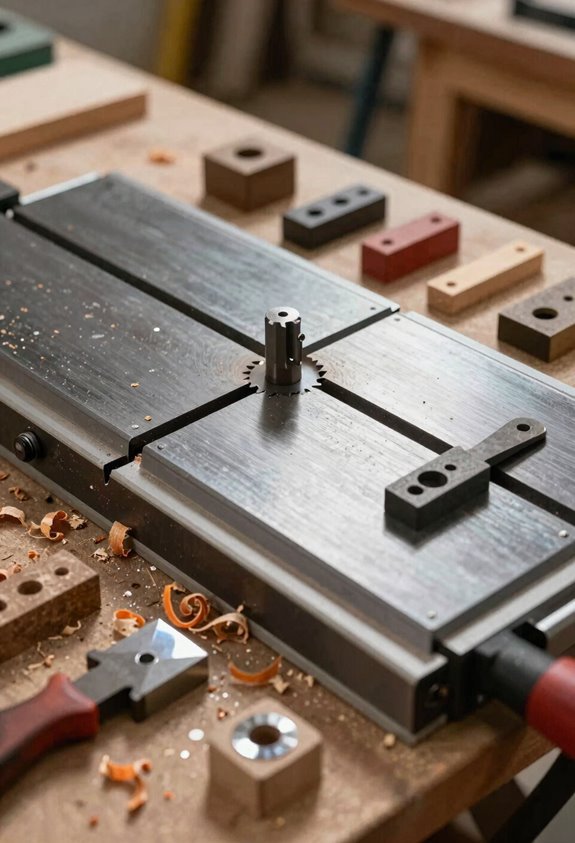
Why do most small woodworking shops start with a table saw? It’s your workhorse for splitting boards lengthwise (ripping) and cutting across the grain (crosscutting). I’ve found that a compact table saw with a sturdy stand keeps my workspace efficient without eating up floor space.
A lockable fence system keeps your blade perfectly aligned, making the difference between sloppy and dead-accurate cuts. You’ll want dust collection compatibility too. Attaching a dust collection system catches sawdust before it settles everywhere, keeping your shop breathable and clean.
Pair your saw with quality blades like Amana Tool’s options, and you’ll notice smoother cuts immediately. Consider SawStop safety systems if injury prevention matters to you. These features make your table saw into a reliable foundation.
Router and Router Table: Precision Joinery in Minimal Space
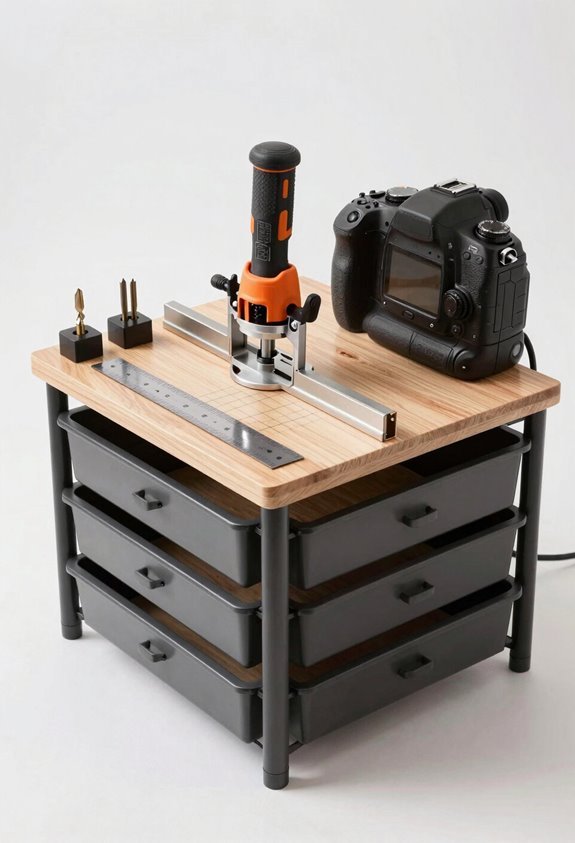
Once you’ve got your table saw handling the strenuous work with rips and crosscuts, a router opens up an entirely different world of woodworking possibilities. I’ve found that pairing a handheld router with a router table creates a powerful two-station setup that doesn’t eat up valuable shop space.
The Festool OF 1400 router, weighing under 10 pounds and delivering 1400 watts, proves you don’t sacrifice power for portability. This combo excels at edge profiling, decorative finishes, and precision joinery. These tasks take basic pieces and develop them into crafted furniture.
What makes this pairing brilliant for tight spaces? Your router table handles guided operations while your handheld router tackles freeform work and templates. Together, they expand your cabinet-making capabilities without demanding extra square footage.
Miter Saw: Fast Crosscuts Without a Dedicated Station
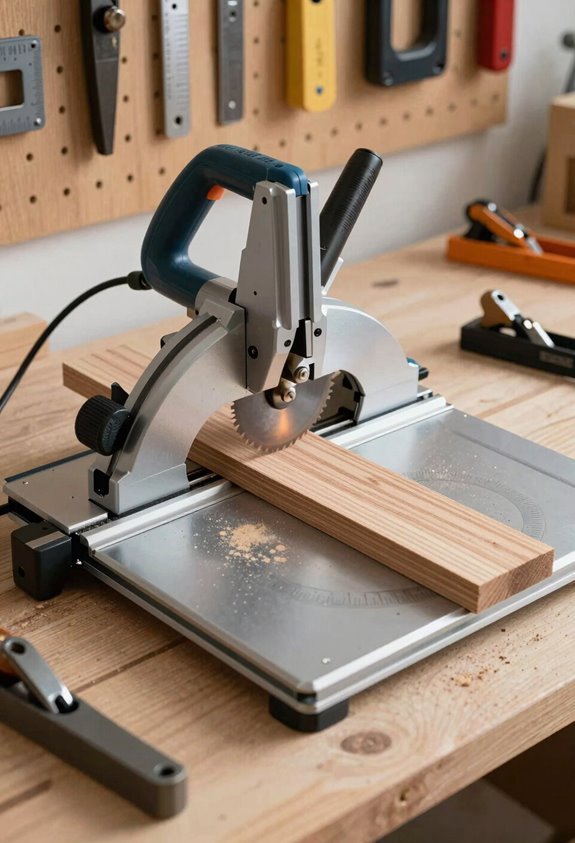
When I’m working in a tight shop, I’ve found that a miter saw gives me quick, clean crosscuts—those cuts made perpendicular to the wood grain—without eating up valuable floor space like a full table saw setup would. You can mount it on a compact stand or wall bracket, then fold it away when you’re done, which means I’m not constantly shuffling equipment around to make room for other tools.
The best part is that positive stops (preset angle markers) let me repeat common angles like 45 degrees for crown molding in seconds, so I’m cutting faster while my table saw stays reserved for the precision rips where it really shines.
Compact Crosscutting Power
A sliding compound miter saw is probably the most efficient way to knock out crosscuts quickly in a small shop without eating up precious floor space. Here’s what makes it perfect for your setup:
- Space-saving options – Wall-mounted stations or compact stands free up floor real estate while keeping your saw accessible
- Precision angle stops – Positive detents let you dial in repeatable angles for crown molding and angled cuts consistently
- Fast throughput – A stable, low-profile stand with an accurate fence system means you’re cutting more boards in less time
- Blade longevity – Reserve your table saw for precision rips while the miter saw handles crosscuts, extending both tools’ lifespans
This versatile tool tackles boards and trim effortlessly, making it a workshop staple that pulls its weight in tight quarters.
Space-Saving Setup Benefits
The real benefit of a sliding compound miter saw isn’t just that it cuts fast; it’s how you can set it up without monopolizing your shop floor. I mount mine on a wall or compact stand with extended front and back tables for stability. This setup lets me make repeatable angle cuts using positive stops, which saves time when I’m cutting multiple pieces to the same length.
Pairing your miter saw with a dust collector keeps your space clean and breathable. I reserve my table saw for precision rips while using the miter saw to break down stock quickly. This approach extends blade life and reduces clutter. A modular stand with proper dust collection creates an efficient, space-conscious workstation that doesn’t demand permanent real estate in your shop.
Drill/Driver and Impact Driver Combo: Speed Up Assembly Without Tool Swaps
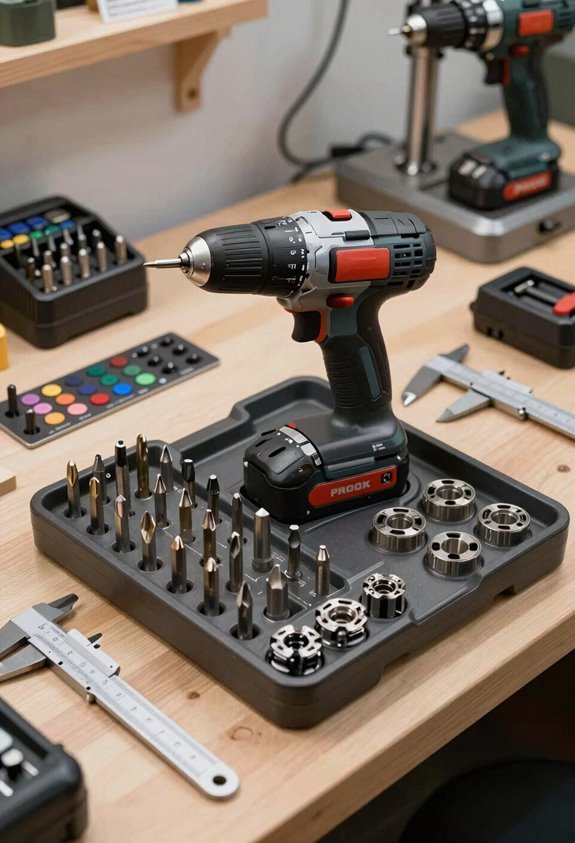
When you’re assembling cabinet doors or installing hardware, switching between tools wastes time you don’t have in a small shop. A cordless drill/driver paired with an impact driver lets you handle everything from delicate pilot holes to heavy-duty fastener work without putting one tool down and picking up another.
You’ll keep your hands busy building instead of hunting for the right tool, which means your projects move faster and your workflow stays smooth from start to finish.
Speed Up Assembly Tasks
Pairing a cordless drill/driver with an impact driver cuts your assembly time dramatically, and you’ll wonder how you ever managed without both. Here’s why this combo improves your workflow:
- Quick bit changes let you switch from drilling to driving without hunting for tools, keeping momentum steady during projects.
- Long-lasting batteries mean you’re powering through casework and furniture assembly without interruptions or dead tools mid-task.
- High torque handles hardwoods effortlessly, while the impact driver delivers rapid fastening that speeds overall throughput significantly.
- Wireless mobility around your shop eliminates extension cords and tool swaps, reducing downtime during jig building and hardware installation.
Pairing these tools with brad-point bits and countersinks gives you precision joinery and secure assemblies. You’ll appreciate the compact, dual-kit approach maximizing versatility while respecting your space constraints.
Eliminate Tool Swaps
How much time do you lose hunting for the right tool mid-project? A drill/driver and impact driver combo eliminates that frustration. You’ll keep both tools within arm’s reach, ready for whatever comes next.
Here’s why this matters: your drill/driver handles pilot holes and precise work, while your impact driver powers through fastening with high torque (rotational force). Quick bit changes mean you’re switching accessories, not tools, a significant workflow difference.
Real benefits:
- Transition seamlessly between drilling, counterboring, and driving
- Minimize interruptions with long-lasting batteries
- Stay focused on your cabinet or furniture build
- Reduce shop clutter by consolidating equipment
You’re not retreating to a workbench for adjustments. You’re staying productive, moving efficiently between tasks. That’s how single-operator woodshops stay competitive.
Dust Collection System: Breathe Easier and Protect Your Lungs
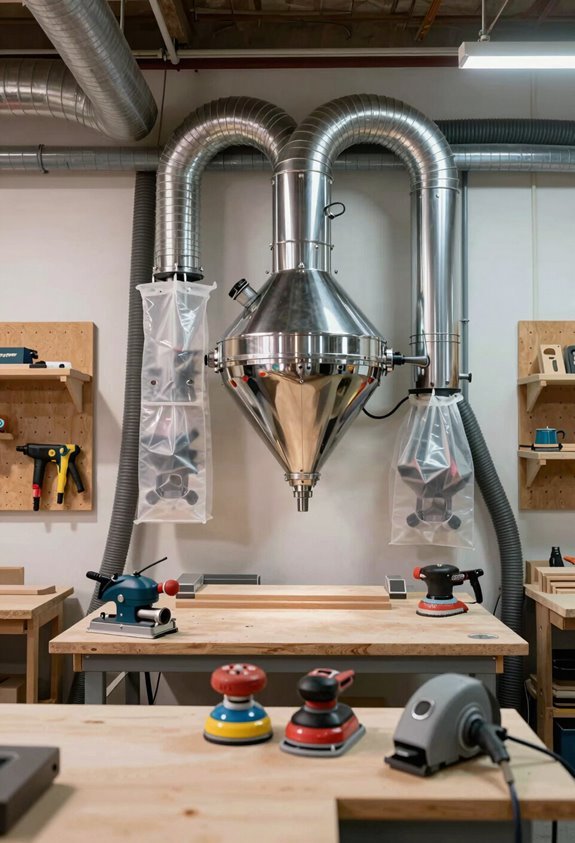
Every woodworking shop creates dust, lots of it. I’ve learned that capturing it at the source improves both safety and air quality. You’ll breathe easier and protect your lungs with a proper dust collection system.
Capturing dust at the source improves safety and air quality. A proper dust collection system protects your lungs and helps you breathe easier.
Here’s what I recommend:
- Start small – Begin with a mobile unit or compact wall-mounted system that fits your current space
- Prioritize airflow – Pair your collector with appropriately sized ducting and hoses to maintain consistent suction across tools
- Upgrade gradually – As your shop grows, expand to higher CFM (cubic feet per minute) capacity for larger operations
- Extend tool life – Regular dust capture prevents buildup, keeping your equipment running longer and performing better
A quality dust collection system isn’t optional. It’s important infrastructure for any serious woodworking space.
Benchtop Jointer and Planer: Prep Stock for Every Project
Stock preparation separates rough lumber from ready-to-use boards, and I’ve found that a benchtop jointer and planer are an essential pair that makes this possible. Here’s what each tool does:
| Tool | Function | Result |
|---|---|---|
| Benchtop Jointer | Flattens and squares edges | Straight, even surfaces |
| Planer | Removes thickness uniformly | Precise final dimensions |
| Both Together | Complete stock prep | Project-ready boards |
I start by running boards through the jointer to create one flat face and straight edges. Then the planer takes over, using its spinning cutter head and powered feed rollers to deliver consistent thickness across the entire board.
This workflow keeps your furniture and cabinet pieces fitting together perfectly. Proper setup and alignment matter tremendously; they’re what separate good results from professional-quality stock.
Circular Saw or Band Saw: Pick Your Cutting Style and Footprint
Once you’ve prepped your stock, you’ll need to cut it down to size, and that’s where the choice between a circular saw and a band saw matters.
I’d consider these key differences:
- Speed and versatility: Circular saws deliver quick rips and crosscuts, perfect for general work in tight spaces.
- Accuracy and curves: Band saws excel at precise, controlled curves and intricate patterns that circular saws can’t match.
- Space requirements: Circular saws stay portable and compact, while band saws demand dedicated floor space.
- Budget reality: Circular saws cost less upfront, making them ideal when money’s tight.
For small shops like yours, I’d pair a circular saw for everyday cuts with a compact band saw for detailed work. If space is limited, consider a track-assisted circular saw system. It delivers accurate cuts similar to expensive track saws without requiring as much room.