I know a cabinetmaker who went from $28/hour to $65,000 annually by specializing in custom kitchen work, and she’s not even in the top tier.
Here’s the thing: woodworking can absolutely make money, but the path from hobby bench to profitable business isn’t obvious.
Your earnings depend on which direction you choose, how you price your work, and whether you’re willing to think strategically about your time. Let’s break down what actually works.
Yes, Woodworking Can Be Profitable: Here’s What the Data Shows
So, can you actually make money doing woodworking? Absolutely. The data backs it up. Entry-level woodworkers earn around $23–$30 hourly after their first year, while cabinet-making specialists reach median incomes near $46,000 annually.
Entry-level woodworkers earn $23–$30 hourly, while cabinet specialists reach median incomes near $46,000 annually.
Here’s what’s realistic: high-end and niche work can generate $60,000 to $100,000+ yearly for those who master their craft.
Your profitability depends on three factors: your market, your specialization, and how efficiently you work. Some successful woodworkers skip custom jobs entirely, instead selling stock products or unique items that don’t require custom orders.
The honest truth? Many combine woodworking with side income streams. You can build sustainable income, but it requires strategic pricing, hard work, and genuine market understanding.
The Earnings Range: What You Can Actually Make by Model and Market

Your actual earnings in woodworking depend heavily on which business model you choose: whether you’re running it as a part-time side hustle, building a full-time specialized practice, or manufacturing niche products at scale. Each path offers different income potential. A weekend maker might earn $500–$2,000 monthly, while a full-time specialist could pull in $46,000+ annually, and someone manufacturing targeted products could exceed $100,000.
I’ll break down what you can realistically expect in each model so you can pick the path that matches your goals and lifestyle.
Part-Time Side Hustle Model
How much can you actually make treating woodworking as a side gig rather than a full-time career? You’re looking at realistic woodworking income that complements your day job without overwhelming your schedule.
Here’s what you can expect:
- $30 per hour starting out on custom pieces
- A dozen jobs yearly funding tools and vacations
- Internet-based widget sales creating passive income streams
- Market-dependent earnings ranging from modest to substantial
Your side hustle success depends on pricing and demand in your area. Early on, you’ll charge conservatively while building your reputation.
As you improve efficiency and establish yourself, you can raise rates and take selective projects. Combining client work with small product sales creates multiple income channels, making woodworking a financial contributor without requiring full-time commitment.
Full-Time Professional Specialization
What separates a woodworker earning $46,000 annually from one pulling in $100,000+? Specialization and strategy.
Full-time professionals who focus on custom furniture command premium pricing because they’ve mastered their craft. You’ll notice the difference when you build a pricing strategy that covers materials, labor, insurance, and tools, not just guessing.
The real money comes from diversification. You’re not just building; you’re offering planning consultations, installations, and repairs. This creates multiple revenue streams.
Top earners in strong markets hit $60,000–$100,000+ yearly by handling roughly a dozen high-value projects annually. They’ve learned that efficiency matters as much as quality.
Your path? Start by identifying your niche. Do custom pieces command more than stock products in your market? That answer shapes everything about your earning potential.
Niche Product Manufacturing Scale
Why do some woodworkers earn $30,000 annually while others hit six figures doing fundamentally the same work? The answer lies in niche product manufacturing scale.
When you target high-end, specialized items instead of generic pieces, you access better profit margins. Here’s what separates thriving woodworkers from struggling ones:
- Premium pricing on custom niche items ($60,000–$100,000+ annually possible)
- Multiple revenue streams through online sales and repeat orders
- Efficient production reducing material costs and waste
- Timeless designs that command customer loyalty
Market demand and competition shape your earnings significantly. While flat-pack competitors like IKEA pressure broader cabinet markets, you’ll find breathing room in specialized corners.
Diversifying your offerings, including different sizes, stock products, and custom variations, stabilizes income and builds momentum. Success isn’t about working harder; it’s about working smarter within your chosen niche.
Three Viable Paths: Custom Work, Stock Products, and Teaching
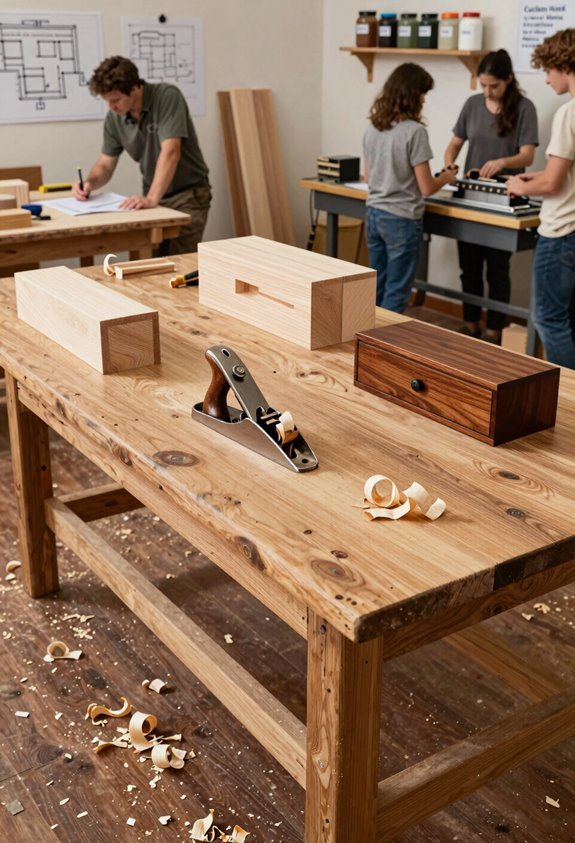
I’ve found that you can’t rely on just one income stream to build a stable woodworking business. That’s why I focus on three distinct paths that work together.
Custom work gives you high profit margins on individual pieces, but you’re constantly hunting for new clients. Stock products let you build inventory once and sell it repeatedly through catalogs or online shops. Teaching workshops or classes brings in steady money per student without needing to produce physical goods.
Each path has different demands on your time and skill, so combining them lets you earn during slow periods when one approach isn’t generating sales.
Custom Work Economics
How you structure your woodworking business dramatically shapes your income potential. Custom work—building pieces tailored to specific clients—lets you command premium pricing when you charge for design expertise, specialized finishes, and installation services. Here’s what you’re managing:
- Labor costs that eat into your margins significantly
- Material expenses that vary with client specifications
- Competition from cheaper flat-pack furniture options
- Time spent on consultations and revisions
The challenge is that your margins tighten fast. You’re trading hours for dollars, and every project demands your direct involvement. Unlike mass-produced items, you can’t scale custom work easily.
Many woodworkers I know pair custom commissions with other income streams, such as stock products or teaching, to sustain steady earnings and reduce financial vulnerability.
Stock Products And Teaching
The most sustainable woodworking businesses don’t rely on custom work alone; they blend three distinct income streams to build financial stability. Beyond one-off commissions, you can create stock products, ready-made items like cutting boards, shelves, or niche furniture pieces that sell repeatedly at higher volumes. These generate consistent revenue with less back-and-forth than custom projects.
Teaching woodworking opens another path. Whether in-person classes or online courses, even a few high-fee sessions accumulate to thousands annually. You’re leveraging your expertise while building community.
Here’s what works: combine all three revenue streams. Custom work brings prestige and larger checks. Stock products provide steady income. Teaching diversifies earnings while reducing volatility. This balanced approach reaches broader markets, aligns with your existing skills, and changes woodworking from unpredictable gigs into a sustainable business.
The Margin Reality: Why Custom Work Tests Your Patience (and Finances)
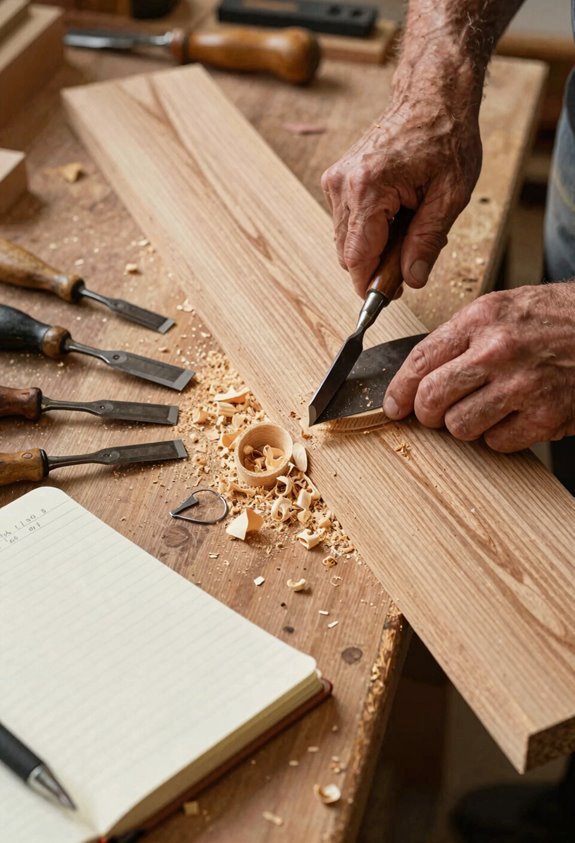
Why does a custom wooden cabinet that takes you forty hours to build often sell for less than you’d expect? Welcome to the margin reality that tests every woodworker’s patience and finances.
The harsh margin reality: forty hours of skilled craftsmanship often yields far less profit than woodworkers deserve or expect.
Here’s what you’re facing:
- IKEA and flat-pack competition undercuts your pricing constantly
- Labor costs consume most revenue, leaving minimal profit margins
- Custom work demands expertise but doesn’t guarantee premium pay
- Market pressure forces you to choose between volume and sustainability
Early earnings hover around $30 per hour, barely livable. That’s why successful woodworkers diversify.
You’ll need additional income streams: teaching classes, selling stock products, offering related services. Even experienced professionals struggle supporting families solely through custom work.
Your market, specialization, and business skills determine viability. Treat this as a profession demanding strategic planning, not just a hobby with guaranteed returns.
Seven Profitable Income Streams for Woodworkers
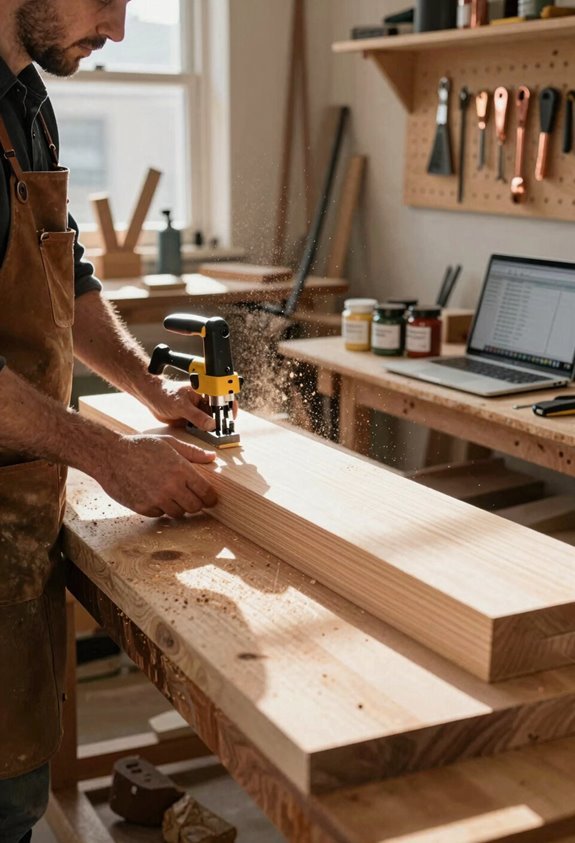
So you’ve realized that custom work alone won’t pay your bills—what’s next? I’ve found that diversifying your woodworking business improves income potential. Here are seven revenue streams worth exploring:
1. Selling Plans & Designs – License your creations online for passive income.
2. Teaching Classes – Share skills locally or virtually; students pay premium pricing.
3. Etsy & Online Marketplaces – Reach customers beyond your region through Amazon Handmade and eBay.
4. Craft Fairs & Local Venues – Direct sales eliminate middlemen, improving your pricing margins significantly.
5. Commissioned Custom Work – High-end pieces command $60,000+ annually for specialized craftsmen.
6. Retail Partnerships – Stock gift shops and galleries; commissions add consistent revenue streams.
7. Digital Products – Sell tutorials, templates, or design files requiring minimal production costs.
These combined approaches stabilize earnings while building your brand reputation.
Stock Products Beat Custom Work for Many Makers: Here’s Why
Most woodworkers start by taking custom commissions, building one-of-a-kind pieces tailored to each client’s specifications. But here’s what I’ve discovered: stock products often beat custom work for profitability and scalability.
Why? Consider these advantages:
- Repeated production cuts labor time dramatically because you’re not redesigning every project
- Predictable pricing eliminates endless negotiations so clients know costs upfront
- Faster turnover means steadier income without waiting months between commissions
- Lower per-unit costs boost your margins as materials and sourcing become efficient
I’ve watched woodworkers succeed selling standard components like five-foot elliptical casings or mitred newel posts. Internet sales for smaller widgets monetize quickly, sustaining income with less variability than custom work alone.
The key? Well-designed, timeless stock designs create steady demand while reducing customization headaches. You’re part of a community of makers who’ve found their groove.
Price Your Work Right or Leave Money on the Table
What separates a woodworker earning $30,000 annually from one making $80,000? Pricing strategy. Here’s the truth: underpricing erodes profitability faster than a dull blade through oak. You can’t compete on price against flat-pack furniture—that’s a losing game.
Instead, focus on specialization. When you develop expertise in a niche, such as custom built-ins or heirloom furniture, customers value your craftsmanship and pay accordingly. Your profitability hinges on three factors: material costs, labor rates, and margins.
Many makers charge $23–$30 hourly after gaining experience, yet premium specialists command far more. Don’t leave money on the table by undervaluing your skills. Research what your market bears, align your pricing with your specialization, and watch your earnings climb.
Teaching Classes: Higher Fees, Lower Physical Demand
You’ve nailed your pricing on custom projects, but there’s another way to earn from your skills that doesn’t require you to spend eight hours hunched over a workbench.
Teaching classes offers higher fees with lower physical demand. Here’s what makes this path work:
- Command premium per-student rates; thousands annually with limited class frequency
- Reduce strain by demonstrating rather than producing all day
- Expand reach through in-person community centers, makerspaces, and online courses
- Combine teaching with paid workshops for stable, diversified income
Your expertise in design, safety, and technique attracts students willing to pay for quality instruction. You’re sharing what you’ve learned, not just building furniture.
This approach protects your body while leveraging your knowledge, creating a sustainable income stream that complements or even replaces intensive production work.
The Hidden Cost of Doing Business: Tools, Insurance, and Equipment
When you’re running a woodworking business, you’ll quickly realize that the actual sawing and building is just part of the equation. You have significant expenses hiding in plain sight that can eat into your profits.
Tools, equipment, insurance, and vehicle costs aren’t one-time purchases; they’re ongoing investments that keep your operation running and protect you legally when something goes wrong on a job site. Understanding these hidden costs upfront is the difference between a profitable woodworking business and one that struggles to break even.
Initial Investment Requirements
How much does it actually cost to start a woodworking business? The initial investment varies considerably based on your ambitions and scope. You’ll need to budget for essential items:
- Quality hand and power tools ($2,000–$5,000)
- Shop equipment like a table saw or jointer ($3,000–$8,000)
- A reliable vehicle for deliveries and material runs ($5,000+)
- Insurance and licensing fees ($500–$2,000 annually)
Most woodworkers find that securing proper financing helps bridge this gap. Banks and small business loans understand that your tools are investments, not expenses. Quality equipment protects your reputation and safety.
Starting small, perhaps with hand tools, lets you grow gradually. As you earn profits, you’ll reinvest strategically in specialized machinery. This approach builds sustainable momentum without overwhelming your budget initially.
Operating Expenses Impact
Once your woodworking business gets rolling, the real financial challenge emerges: keeping up with the costs that happen month after month. You’ll discover that tools wear out, equipment needs maintenance, and insurance premiums arrive like clockwork. These aren’t one-time purchases; they’re ongoing expenses that directly affect your bottom line.
| Expense Category | Monthly Cost | Annual Impact | Priority |
|---|---|---|---|
| Tools & Maintenance | $200–$400 | $2,400–$4,800 | High |
| Insurance & Health | $300–$600 | $3,600–$7,200 | Critical |
| Vehicle & Transport | $400–$800 | $4,800–$9,600 | High |
You’re investing in reliability. Quality tools prevent costly mistakes. Insurance protects against liability. Your vehicle gets you to job sites.
Smart planning stabilizes cash flow and keeps your business thriving.
When You Need a Secondary Income Source (and When You Don’t)
Should you pursue woodworking specifically to replace your day job? Honestly, not right away. Most woodworkers I know treat it as a side hustle first. Here’s what determines if you’ll need extra income:
- Early earnings average $30 per hour, below living wage standards
- Pricing and demand fluctuate based on your market and specialization
- Lean periods happen; you’ll need financial cushion
- Diversified revenue streams (stock products, plans, teaching) beat custom work alone
You’ll sustain this craft longer by building diversified revenue streams rather than depending solely on custom projects. Many successful woodworkers rely on a partner’s income or multiple income sources during slower seasons.
Once you establish yourself and develop pricing strategies that work, woodworking as a side hustle becomes more substantial.
Premium Niches Where Woodworkers Command High Prices
Now that you understand the importance of diversifying your income streams, it’s time to look at where the real money actually lives in woodworking.
Premium pricing happens when you specialize in custom, high-end work rather than mass-produced items. I’ve found that bespoke furniture and design/build projects for banks, hospitals, and luxury homes command margins that generic wood products simply can’t touch.
| Niche | Price Range | Margin Potential |
|---|---|---|
| Custom cabinetry | $5,000–$50,000+ | 40–60% |
| Bespoke furniture | $3,000–$100,000+ | 50–70% |
| Specialty millwork | $2,000–$30,000+ | 35–55% |
Your craftsmanship matters here. Stocking distinctive components, like five-foot elliptical casings, reduces labor costs while justifying premium pricing. Elegant, timeless designs differentiate you from competitors.
You’ll attract clients willing to pay substantially more for tailored specs, finishes, and material choices that reflect their vision.
Planning for the Long Haul: Physical Sustainability and Aging
How do you keep making money from woodworking when your body starts sending warning signals?
You’re not alone in facing this challenge. Smart woodworkers plan ahead for aging and sustainability by:
- Building emergency savings now; aim for six months of expenses
- Getting quality health insurance before problems arise
- Investing in ergonomic tools that reduce joint strain
- Developing side skills like finishing, design, or consulting
Diversification keeps your income flowing. I’ve seen craftsmen shift toward less physically demanding work: custom design, teaching, or managing projects while younger hands do heavy lifting.
Consider supplemental income through related trades: plumbing, electrical work, or general carpentry expertise. These skills strengthen your business resilience.
The long-haul approach isn’t pessimistic; it’s protective. You’re securing your craft’s future by respecting your body’s limits today.
The Mindset Shift: From Hobby Dabbler to Profit-Minded Maker
Turning your woodworking passion into actual income means you’ve got to flip a mental switch: you’re no longer just crafting for fun, you’re running a business. This shift requires three core changes: treat your craft like a profession by pricing your work strategically (not undercharging because you enjoyed the project), stay disciplined about which projects you take on (focusing on what pays best or builds your reputation), and build intentional systems rather than just accepting whatever work comes your way.
Without this mindset shift, you’ll likely find yourself working long hours for wages that don’t reflect your skill. The difference is clear: making money from woodworking versus just spending money on it.
Treating Craft As Business
What separates a woodworker who makes pocket change from one who builds a real income? The answer’s simple: treating your craft like a business, not a hobby.
Here’s what profit-minded makers do differently:
- Set intentional pricing based on materials, labor, and overhead, not just guessing
- Diversify income streams through commissions, retail products, and teaching
- Track every expense and know your actual hourly rate
- Build systems that scale without burning you out
You’ll need to think strategically about which projects pay well and which drain your time. That means choosing niches where customers pay premium prices for quality.
When you stop undercharging and start calculating real costs, your woodworking becomes a legitimate income source instead of a side gig. This mindset shift separates hobbyists from professionals earning $60,000–$100,000+ annually.
Pricing With Intention
Why do some woodworkers struggle to earn more than pocket money while others build $60,000–$100,000+ annual incomes from the same craft? The difference isn’t talent; it’s pricing with intention.
You’ve got to shift your mindset from hobbyist to professional. That means understanding your actual costs: materials, labor, and overhead. Then you calculate margins, the profit you keep after expenses. Without healthy margins, you’re just working hard for someone else’s benefit.
Here’s the reality: your pricing reflects your profitability. You can’t reinvest in better tools or education without it. Median cabinetmakers earn around $46,000 yearly, but those treating woodworking as a genuine business are hitting $60,000–$100,000+.
The shift requires discipline. You’ll price based on market value, not just time spent. You’ll build multiple income streams: custom work, stocked pieces, plans, rather than chasing one-off commissions.
That’s how you move from dabbling to belonging to a profession.
Strategic Focus And Discipline
How do you actually stop spinning your wheels and start building real profit? Strategic focus means choosing what you’ll make and who you’ll make it for, then sticking with it.
Here’s what separates hobbyists from professionals:
- Pick your niche (custom furniture, cutting boards, or teaching) and master it
- Set boundaries on projects that don’t align with your goals
- Track your time ruthlessly to spot where hours disappear
- Build diversified income streams so you’re not dependent on one revenue source
Professional discipline isn’t glamorous. It’s saying no to side projects. It’s showing up even when inspiration fades.
Your First 90 Days: Building Profitable Systems From Day One
When you’re just starting out in woodworking, you’ve got a narrow window to prove your business can actually make money. Those first three months are necessary for setting yourself up right.
I’d recommend establishing your pricing strategy immediately by setting a realistic hourly rate that covers materials, labor, and overhead. Build a simple project workflow with standardized estimates and checklists to reduce mistakes and speed things up. Start with small-to-medium projects that test demand while keeping your workload manageable.
From day one, track profitability metrics: hours worked, material costs, overhead, and revenue. This data shows you what’s actually working. Generate steady commissions through local outreach and online presence. These early wins prove your concept before scaling, keeping burnout at bay while building momentum.