Most woodworkers waste about 30% of their shop space through poor planning, but you won’t make that mistake.
I’ll walk you through creating an efficient workshop that grows with your skills, starting with one essential decision that determines everything else.
Measure Your Space and Plan for Growth
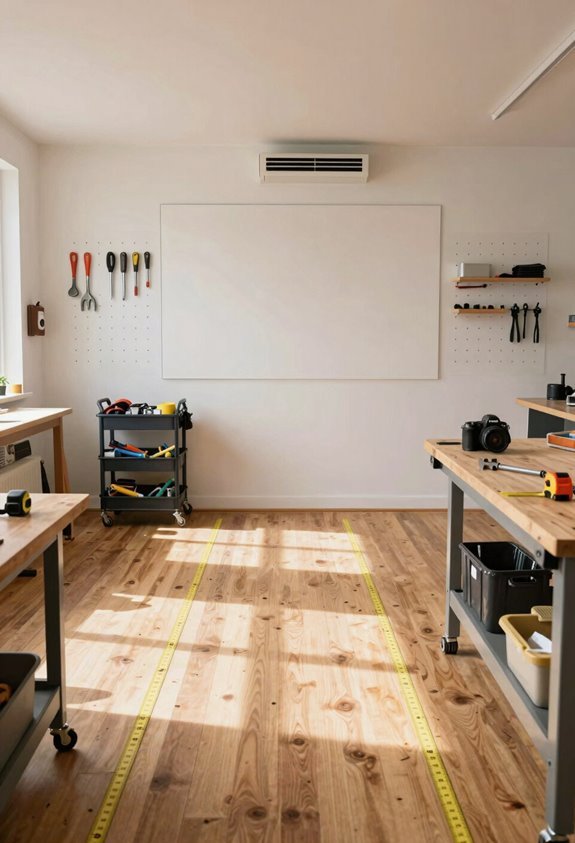
Before you buy a single tool or machine, you’ll want to figure out what you’re actually working with. Grab a measuring tape and sketch your space in square feet. I map out distinct zones: lumber storage, a cutting area, dust collection equipment, and my workbench. This workshop layout prevents me from constantly backtracking.
Leave clearance around benches and walls; you’ll need room for long boards and future machines. Plan your electrical access now, since you can’t move outlets easily later. Consider moisture resistance and ventilation too, since tools last longer in stable conditions.
Think ahead. That empty corner might seem perfect today, but tomorrow you’ll want space for expanded dust collection ducting or a new machine. Smart space planning makes growth simple, not stressful.
Map Your Workflow Before You Place Anything
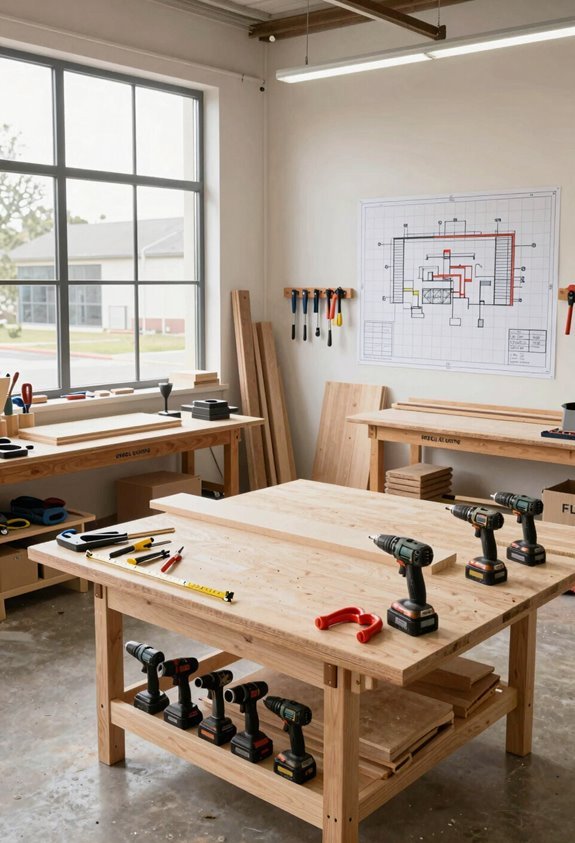
Before you buy a single tool, I want you to imagine a piece of rough lumber walking through your shop: where does it go first, and what happens next? You’ll want to track wood’s journey from that initial breakdown stage through milling (planing, jointing, sawing) and finally to assembly and finishing, because this path becomes your shop’s backbone.
Think of it like an assembly line: position your lumber rack near where you start, run your dust-heavy machines (table saw, planer, jointer) along one efficient line to minimize wasted steps, and keep your finishing area separate so dust doesn’t settle on your fresh stain.
Track Wood’s Journey
How’d you like your wood to move through your shop like a well-oiled machine instead of bouncing around like a pinball?
Start by mapping your wood’s complete journey. Position your lumber rack at the entrance, then flow toward breakdown, milling, assembly, and finishing zones. Each station should connect logically to the next, minimizing backtracking.
Place your breakdown station near the lumber rack. This reduces moving heavy rough stock across your woodworking shop layout. Next, align power tools in feed-direction sequence: table saw, jointer, then planer. This natural progression keeps workpieces moving forward efficiently.
Don’t forget dust collection systems. Position them near planning and milling areas with blast gates directing airflow. Maintain clear workflow pathways and ergonomic spacing around stations. Your wood, and your back, will thank you.
Arrange Machines Sequentially
The key to a functional woodworking shop isn’t fancy equipment; it’s smart placement. Before you position a single machine, map your workflow from rough lumber to finished piece. This prevents wasted steps and frustration.
Start at your shop entrance with breakdown and rough-cut areas, then move through milling, finishing, and assembly zones in order. Position your table saw centrally since you’ll use it constantly. Align your jointer and planer in the same feed direction to keep stock moving smoothly without backtracking.
Key placement strategies:
- Locate dust collection near each debris-generating machine
- Install blast gates to direct airflow where you need it most
- Group milling tools together for efficiency
- Keep finishing areas near ventilation
This sequential arrangement improves your workflow, reducing unnecessary movement and keeping your shop organized.
Build a Dust Collection System That Works
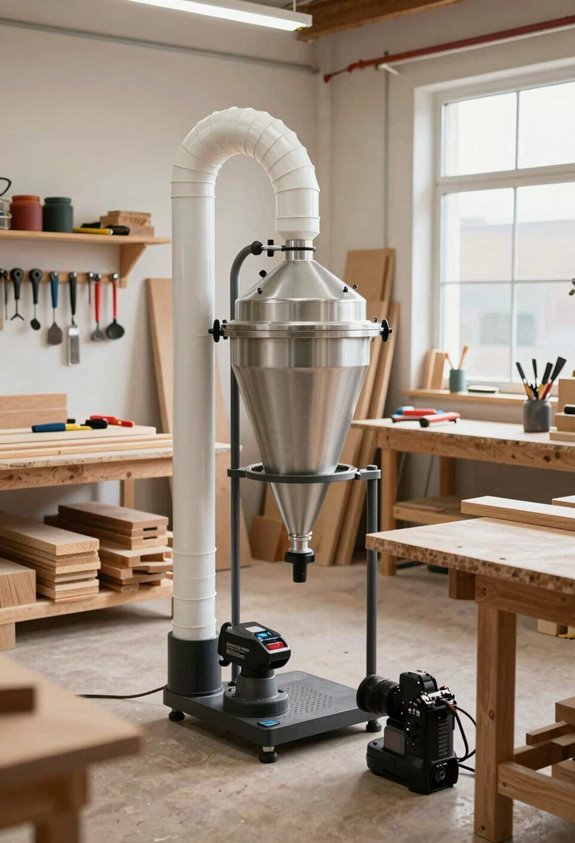
Now that you’ve mapped your workflow, you need a dust collection system that actually captures debris at the source, whether that’s fine dust from your router or thick shavings from your planer. I’ll help you figure out what size collector you need, usually 1 to 1.5 HP for a multi-machine shop.
How to run your ductwork efficiently with 4-inch tubing and where to place blast gates are key considerations. You want to position blast gates so you’re pulling maximum airflow when each machine runs.
Understanding Your Dust Collection Needs
Why do some woodshops feel clean and easy to breathe in while others choke you with sawdust after five minutes? The answer lies in understanding your dust collection needs before you invest in equipment.
Your shop’s dust profile depends entirely on which machines you’ll use. Here’s what matters:
- Thickness planers produce large shavings with low-velocity dust, requiring moderate collection capacity
- Routers, tablesaws, and bandsaws generate fine dust demanding high-capacity systems
- 4-inch ducting with a central dust collector beats small 1.5-inch shop vacs for serious work
- Blast gates let you direct vacuum only to active tools, maximizing velocity where you need it
A 1 HP to 2 HP motor-driven central dust collector handles most home shops effectively. Position it on a lower level and route flexible 4-inch piping upward. This setup keeps noise down while capturing dust at the source, creating that comfortable workshop environment you’re after.
Selecting The Right System Size
How do you know if you need a 1 HP portable unit or a beefy 2 HP centralized system? It depends on your shop’s size and machines.
Consider these factors:
- Single machine? A 1 HP blower handles one tool fine.
- Multiple machines? You’ll want 1.5 HP or higher for concurrent operation.
- Duct sizing matters. Standard 4-inch ducting works for most setups, but larger shops need bigger pipes to maintain static pressure.
- Install blast gates near each machine so only active tools draw air, keeping velocity strong.
High-chip generators like planers demand serious capacity. Think of it this way: more machines and finer dust mean you’re investing in a robust HP blower system. Don’t skimp here, as proper dust collection protects your lungs and equipment.
Strategic Ductwork And Gate Placement
Once you’ve picked your dust collector size, the real work begins: getting the air to flow where it needs to go. I’ll walk you through creating a ductwork system that actually works.
You’ll need 4-inch diameter piping for your main runs. This size keeps airflow velocity high enough to move dust effectively. Here’s what makes the difference:
- Install blast gates near each machine’s dust port to control which tool’s connected
- Open only the active machine’s gate to maximize suction power where you’re working
- Use flexible 4-inch piping to connect multiple machines to your central dust collector
- Position your collector downstream near your dustiest work area to improve efficiency
This setup means you’re not spreading weak suction everywhere. Instead, you’re concentrating power exactly where you need it.
Position Your Table Saw for Maximum Accessibility
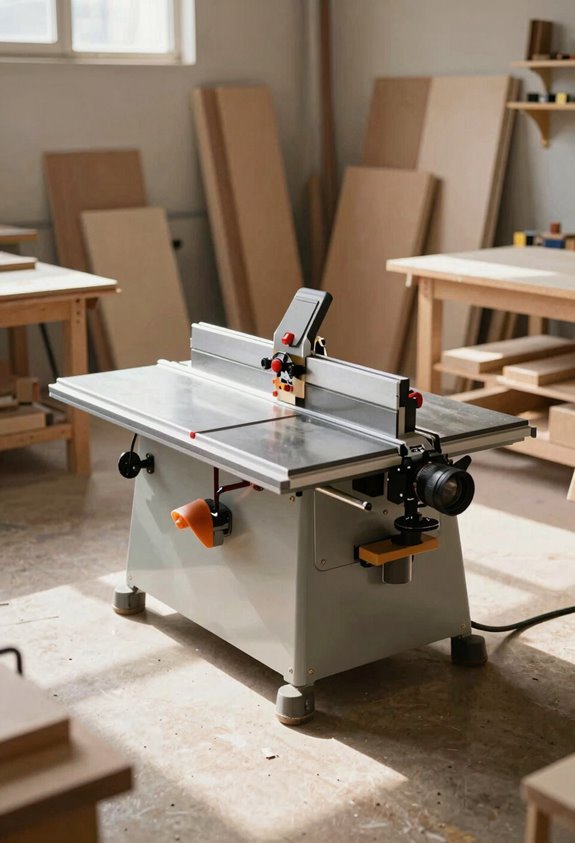
Your tablesaw is the heart of your shop’s milling station, and where you plant it matters more than you’d think. I position mine centrally so I can access it from all sides without squeezing past obstacles. This accessibility means I can rip boards lengthwise or crosscut them without repositioning everything.
I keep the outfeed area clear and aligned with my jointer and planer. They’re all facing the same direction. This setup minimizes my movements between tools.
For dust collection and electrical outlets, I’ve run short, straight connections nearby. Long hoses lose suction, so keeping everything close boosts efficiency. I maintain at least six feet of clearance around the saw for maneuvering sheet goods and long boards safely.
Create a Dedicated Assembly Station
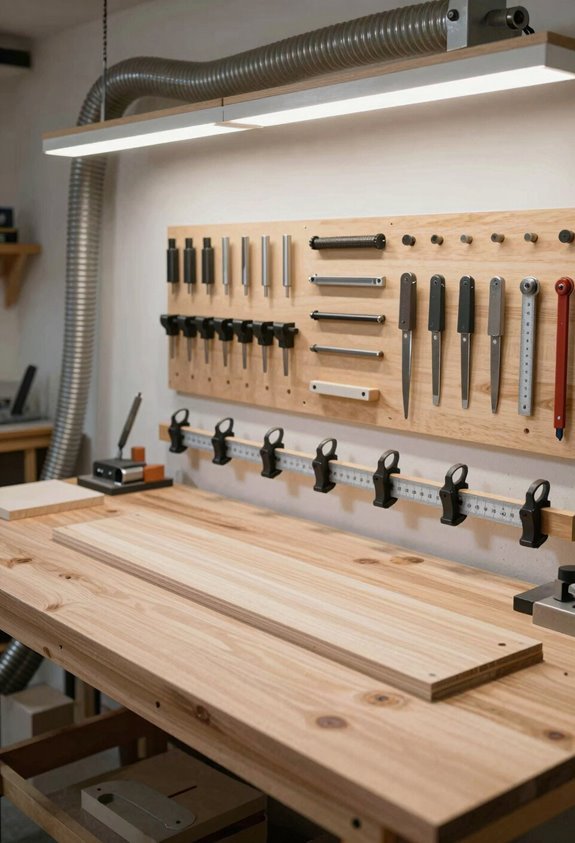
Your assembly station is where all the pieces come together. I’m going to show you how to set it up for maximum efficiency and comfort.
You’ll want to think about where you place your assembly table and what specs will actually work for your projects, because the right setup saves you hours of frustration. A smart central location and a properly sized table will improve your entire workflow.
Central Location Benefits
Why does placement matter so much when you’re putting a project together? Your assembly station’s central location is the backbone of an efficient workflow. When you’re positioned in the middle of your shop, you’ll minimize wasted steps between finishing, sanding, and final assembly areas.
A well-placed assembly station delivers real advantages:
- Reduced movement between work zones keeps your energy focused on quality
- Ample clearance on all sides lets you rotate large parts without constraints
- Nearby dust collection access maintains a clean workspace during glue-ups
- Storage accessibility for clamps and jigs puts tools within arm’s reach
This central location keeps you connected to your supplies and equipment. You’ll notice projects move faster when everything’s nearby.
Plus, distance from loud machinery means you can concentrate on precision work without constant noise interruption.
Assembly Table Specifications
Now that you’ve picked out your central location, it’s time to build the actual assembly station—the table itself. Your assembly table is your command center, so invest in a sturdy workbench with a flat, true surface. Aim for a height around 34–36 inches, roughly your hip level, to keep your workspace ergonomics comfortable during long assembly sessions.
Mount an integrated vise or clamping system directly to the table. This keeps parts secure without eating up precious space. Position your small parts organizer within arm’s reach so screws and fasteners stay handy.
Install dust collection nearby to maintain a clean workspace layout. Finally, reserve corner space for offcuts and scrap storage. This prevents clutter while keeping test fit areas accessible. Your storage organization makes assembly smoother and faster.
Place Your Workbench Where You’ll Do Detail Work
Where should I put my workbench, and how does its location actually matter? Your bench’s placement directly affects how efficiently you’ll complete detail work and finish pieces. I’ll position mine centrally near my assembly area to minimize walking and keep everything accessible.
Here’s what I’m prioritizing:
- Easy tool access: Hand tools and templates stay within arm’s reach for precision work
- Stable foundation: I’m ensuring ample, flat surface space at elbow height for comfortable detail work
- Workholding setup: Clamps and vises at the bench edge secure pieces quickly during shaping and joining
- Proper lighting: Natural light combined with adjustable task lighting helps me match colors accurately
This strategic placement makes my bench the command center where quality craftsmanship happens.
Arrange Stationary Machines Along the Walls
How you arrange your stationary machines can make or break your workshop’s efficiency. I’ve found that placing my table saw, jointer, and planer against walls maximizes floor space and lets long boards pass freely. Your table saw works best positioned centrally or near a wall with ample outfeed clearance, the space behind the saw where wood exits safely.
Group related machines in a linear layout to minimize walking between stations. This workflow efficiency matters when you’re moving between milling and finishing areas repeatedly.
Don’t forget dust collection. I run dedicated lines from each wall-mounted machine with blast gates nearby, so you’ll control which tool draws dust selectively. Leave enough clearance around each machine for material handling, and mount storage racks within arm’s reach. You’ll appreciate the setup instantly.
Store Lumber at Your Workshop Entry
Your lumber storage location makes a bigger difference than you’d think. I’ve learned that positioning sheet goods and solid stock near your workshop entry cuts down on carrying distance from your vehicle. This setup saves time and energy while keeping your workspace organized.
Strategic lumber placement near your workshop entry eliminates wasted time and keeps your workspace organized and efficient.
Here’s what I recommend for smart lumber storage:
- Position sheet goods at the entrance to minimize transport distance
- Use vertical storage for long boards to prevent warping and improve visibility
- Keep horizontal boards on a lumber rack for easy access
- Maintain a dedicated drying space indoors for moisture-sensitive wood
This arrangement optimizes your workflow considerably. I keep different wood species clearly labeled nearby, which eliminates clutter searching for materials.
With everything accessible at your workshop entry, you’ll spend less time hunting supplies and more time actually building.
Keep Hand Tools Within Arm’s Reach
Ever notice how much time you waste walking back and forth to find a hammer or chisel? I’ve learned that keeping hand tools within arm’s reach improves your workflow. I mount frequently used tools on pegboard or wall-mounted storage directly above my workbench. This simple setup reduces search time and keeps my working footprint clear.
| Tool Type | Storage Method | Benefit |
|---|---|---|
| Chisels | Magnetic strips | Quick access, visible organization |
| Screwdrivers | Wall-mounted rack | No digging through drawers |
| Marking tools | Pegboard near bench | Less setup time |
I arrange related hand tools together: chisels, planes, and marking tools grouped logically. This grouping streamlines both setup and cleanup. The key is ensuring I can grab any tool without moving others.
Tool accessibility matters because it keeps me working, not searching. You’ll feel the difference immediately.
Choose Smart Storage That Scales
What happens when your shop grows and you’ve already filled every wall? I’d plan ahead with scalable storage that grows with you.
Start with essentials using wall-mounted storage and pegboards for hand tools. This foundation keeps your workflow efficient without overcrowding. As your collection expands, vertical lumber storage racks and sheet-goods holders maximize space while preventing warping. Long boards stay horizontal on racks.
Mobile storage offers significant advantages. Rolling tool cabinets and utility carts let you relocate equipment as projects demand:
- Shift workstations without moving permanent installations
- Adapt layouts for different project types
- Add cabinets gradually without renovation
- Keep frequently used items accessible
This approach means you’re never locked into one design. Your shop evolves naturally, staying organized and functional as your skills and tool collection develop together.
Run Power and Lighting Before You Move In
How many times have you wished an outlet was just three feet to the left?
How many times have you wished an outlet was just three feet to the left? Plan electrical service carefully to avoid future frustration.
Before you move machines in, plan your electrical service carefully. I’d recommend at least 60 amps for a small shop with one or two large machines. Install outlets along walls at 12–16 inch spacing so you’re never scrambling for power.
Run 4-inch dust collection ductwork alongside power lines now. Retrofitting later is frustrating and expensive.
For lighting, mix bright white task lights (5,000–6,000K) with ambient fixtures. Maximize natural light through windows or roof access when possible.
Add a subpanel or labeled breaker box in your shop space. This simplifies future expansion and keeps circuits organized. Include conduit paths for upgrades like additional outlets or centralized systems.
Getting this right upfront saves headaches and money down the road.
Keep Your Shop Safe and Breathable
Now that your power and lighting are in place, it’s time to tackle something that’ll affect your health every single time you step into the shop: dust and air quality.
I’ll set up a dust collection system that captures wood particles at the source, right where they’re created. Here’s what I’m installing:
- 4-inch ducting with blast gates connected to each machine for selective operation
- A centralized dust collector (1–2 HP) positioned on a lower level to reduce noise
- High-airflow, low-velocity equipment for planers and finish work to catch chips before they float around
- Air filtration and open ventilation options to maintain breathable air throughout my workspace
I’m designing tight ductwork with minimal leaks to maintain strong suction at every dust port. Regular ventilation prevents cumulative buildup, keeping my shop safe and comfortable for serious work.