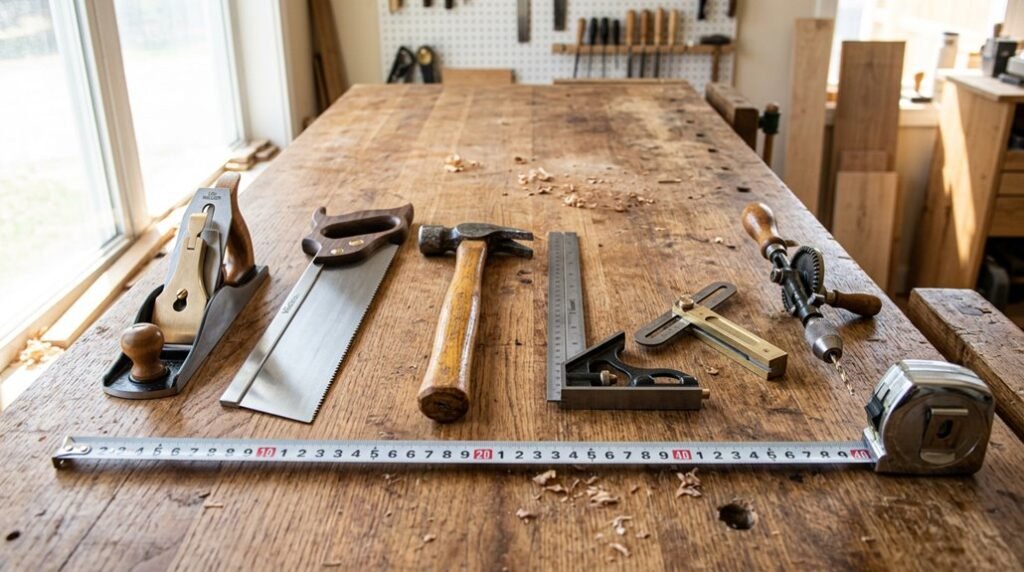
Did you know that most woodworking mistakes come from using the wrong tools rather than lacking skill? I’ve seen beginners improve their projects by investing in just seven foundational tools.
Whether you’re building a simple cutting board or a sturdy shelf, you’ll need the right equipment to work safely and accurately. So what are these essential tools, and how do you choose them?
Put Safety First: Essential PPE Before Your First Tool
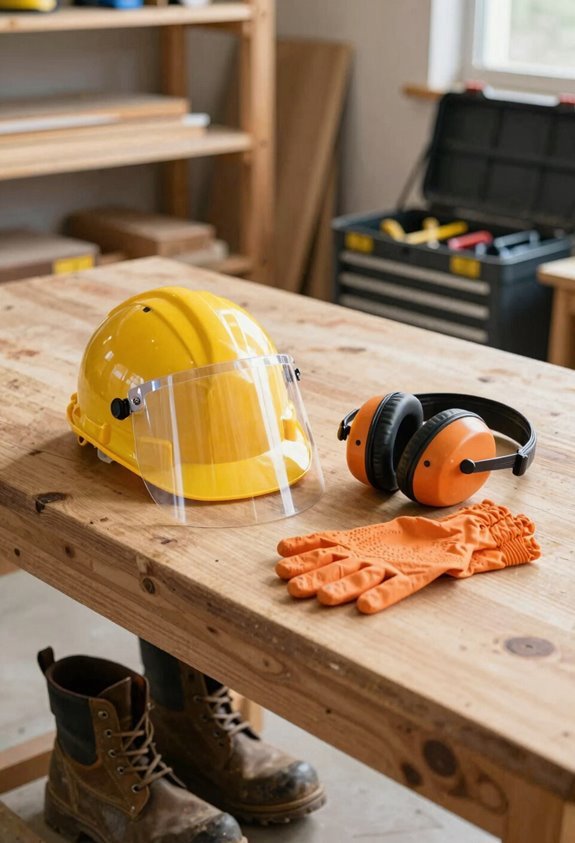
Why do you think professional woodworkers wear safety gear even when working on simple projects? They’ve learned that shop safety isn’t optional; it’s required.
Before you touch your first tool, invest in proper PPE. Here’s what you’ll need:
Eye Protection: Safety glasses or a face shield guard against flying debris and wood chips during cutting and shaping.
Hearing Protection: Earplugs or earmuffs reduce loud noise from saws, planers, and sanders during extended work sessions.
Dust Safety: A dust mask or respirator prevents you from inhaling fine particles. Consider a dust collection system for your workshop.
Smart Storage: Organize tools after each use and secure sharp edges safely.
Understanding basic first aid, treating minor cuts and recognizing when you need professional help, completes your safety foundation. You’re joining a community that respects the craft by protecting itself.
Master Layout With Marking and Measuring Tools
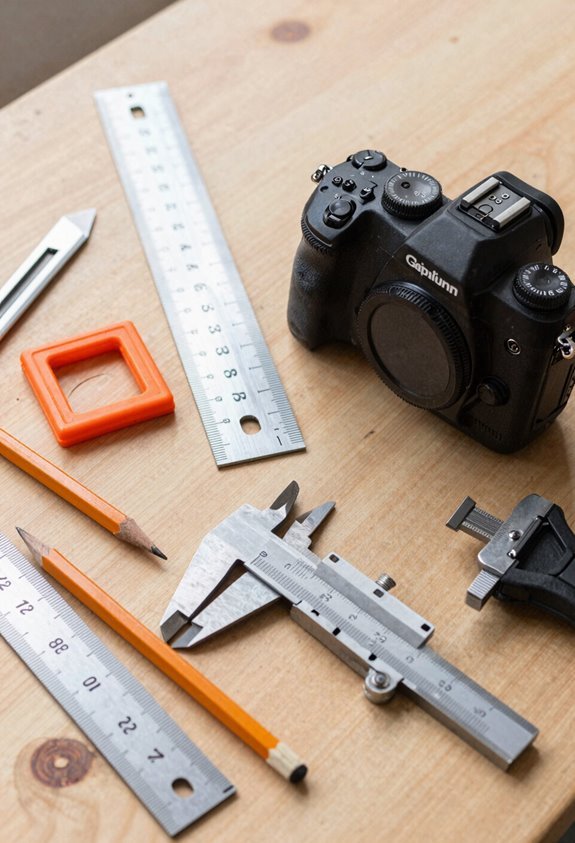
I’ve learned that precision in woodworking starts before you even pick up a saw; it’s all about using the right marking and measuring tools consistently. You’ll want a marking knife or pencil for layout lines, a square or bevel gauge for 90° and angled cuts, a marking gauge (wheel type works great) for transferring exact distances, and a reliable tape measure, because these tools reduce errors across all your projects.
When I keep the same set of tools on hand and verify my dimensions twice with a straight edge, I catch mistakes before they become expensive problems.
Precision Through Consistent Tools
How’d you like to cut a board perfectly the first time instead of wasting material on mistakes? You’ll get there by using the same tools consistently.
Grab these essentials: a marking knife for crisp lines, a marking gauge for repeatable measurements, a straight edge for reference, a square or try square for checking angles, a tape measure for initial dimensions, and a 30 cm rule for precise details.
Here’s the thing: when you stick with identical tools, your hands develop muscle memory. You’ll hold them the same way every time, marking at consistent angles and pressures.
This consistency improves layout work. Your joints align better. Your cuts require less adjustment. You’re building reliability into every project before the saw even touches wood.
Measurement Techniques And Accuracy
When you’ve got your marking tools ready, the real work happens in how you use them. I’ll share the techniques that’ll make your layouts accurate and your cuts clean.
| Tool | Purpose | Best Practice |
|---|---|---|
| Marking knife | Creates precise lines | Use light pressure |
| Tape measure | Transfers dimensions | Measure twice, cut once |
| Marking gauge | Ensures consistency | Wheel type preferred |
| Square/bevel gauge | Guides 90° and angles | Check alignment first |
The “measure twice, cut once” rule isn’t just catchy; it’s your safety net. I always use a straight edge for long layouts, keeping my lines visible and true.
When holding your tape measure’s end gets awkward, digital options work great. These techniques help you develop basic tools into precision instruments, helping you join our community of confident woodworkers.
Choose Your Essential Hand Saws and Chisels
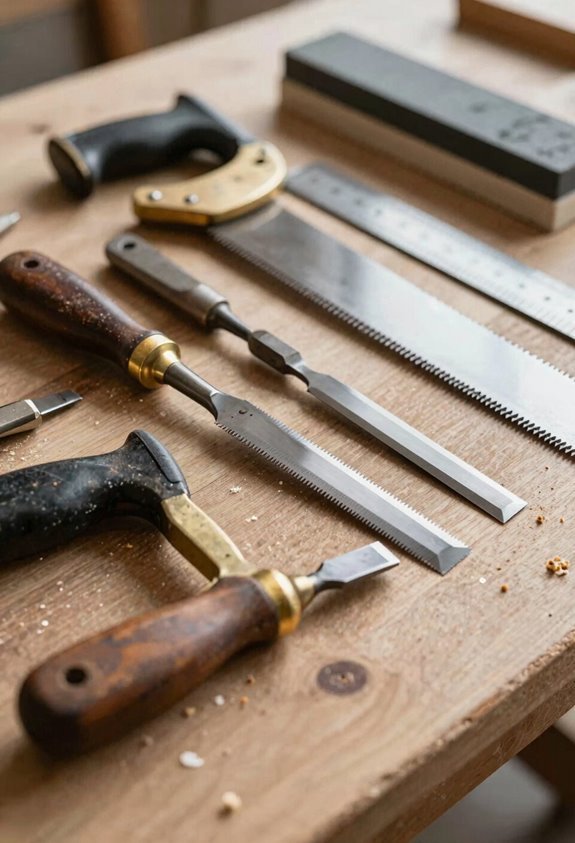
Why do you need both saws and chisels when you’re just starting out? They’re your foundation for creating tight joints and smooth surfaces.
Saws and chisels form your foundation for tight joints and smooth surfaces—essential tools every woodworker needs.
Start with two hand saws: a dovetail saw for precise joinery and a ryoba or western back saw for general cutting. You’ll appreciate having both once you’re tackling different projects.
For chisels, grab mortise chisels in 6 and 13 mm sizes. They’re built tough for creating clean joints. Add a block plane and No. 4 smoother for finishing surfaces.
These tools work together. Your saws make the cuts, and your chisels refine them. Investing in quality hand saws and chisels now means you’re joining a community of woodworkers who value precision and craftsmanship. You’re building real skills with real tools.
Add Power: Cordless Drill and Circular Saw for Beginners
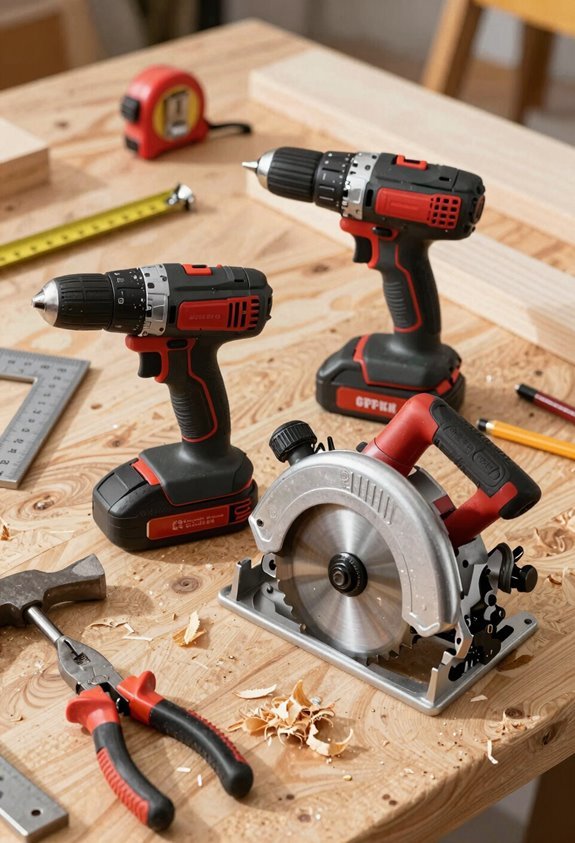
Where do hand tools end and power tools begin? That’s when you’re ready to join the ranks of serious beginner woodworkers.
I’d recommend starting with an 18-volt cordless drill. It’ll handle hole drilling and screw driving with ease, making pocket holes and fasteners straightforward. Pair it with a circular saw for straight cuts through sheet goods and lumber; you’ll work faster than any hand saw allows.
Choose a 7.5″ to 10″ carbide-tipped blade. That size balances cutting capacity with manageability.
These power tools complement each other beautifully. You’ll drill holes first, then drive fasteners on assembled pieces. Add basic accessories like drill bits, screwdriver bits, and simple jigs to expand what you can accomplish without overcommitting early.
Sand and Shape With a Sander and Router
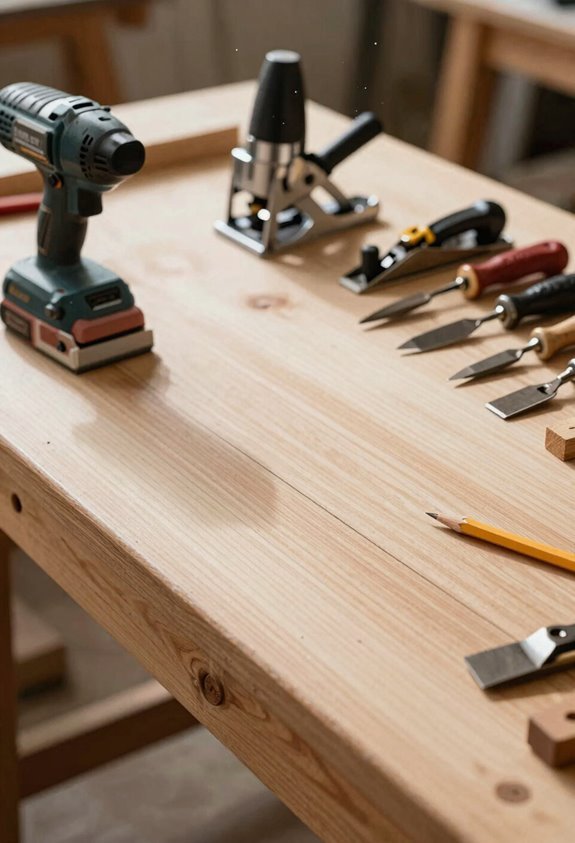
Now that you’ve cut and drilled your pieces, you’ll want to smooth those surfaces and add shaped details. A random orbital sander and a router are the tools for this job.
A random orbital sander blends circular and orbital motions to eliminate the swirl marks that other sanders leave behind, making it perfect for beginners because it’s forgiving and versatile across different wood types. Once you’ve sanded your project smooth, a router lets you shape edges with roundovers or chamfers, giving your work that polished, finished look.
Random Orbital Sanding Basics
When you’re ready to smooth out rough wood surfaces and prep your project for finishing, a random orbital sander becomes one of your best tools in the workshop. This tool combines circular and orbital motions, moving in tiny circles while also shifting position, to eliminate swirl marks that other sanders leave behind.
I’d recommend stocking sanding discs in multiple grits: 80 for rough work, 120 for general shaping, and 180 for pre-finishing. Jump to 320 grit between finish coats for that silky result you’re after.
Look for models with solid vibration control that reduces hand fatigue, reliable dust collection to keep your workspace clean, and variable speed settings. These features let you adapt to different woods and projects without frustration.
Router Versatility And Applications
While a random orbital sander smooths surfaces flat, a router does the opposite; it shapes, cuts, and profiles wood in countless creative ways. I’ll help you discover this tool’s potential with these capabilities:
- Edge profiles – Round over sharp corners or chamfer edges for polished looks
- Template routing – Reproduce identical shapes using guides and jigs
- Joinery – Cut dovetails and mortises for strong, professional joints
- Flush trim – Trim veneer or inlays perfectly level with your workpiece
Start with a plunge router for maximum flexibility, or a compact trim router if you’re budgeting. Invest in quality bits—roundover, chamfer, flush trim, and dovetail—rather than buying large sets filled with unnecessary tools.
Pair your router with appropriate jigs and templates. You’ll create cleaner joints and professional-looking edges that’ll impress anyone who sees your work.
Set Up Your Workbench and Clamp System
Your workbench is the foundation of every woodworking project, so getting it right significantly improves how smoothly your work goes. Start by setting your workbench height at elbow level. This sweet spot gives you control without straining your back.
Next, invest in a solid clamping system. You’ll want a bench vise for holding pieces steady and multiple bench clamps in various sizes. Bar clamps, F-clamps, and pipe clamps create the versatility you need for cutting, joinery, and assembly work.
Don’t overlook the practical stuff. Good lighting helps you see your cuts clearly and spot mistakes early. A dust collection setup keeps your workspace clean and protects your lungs. Finally, organize your tools on pegboard or in drawers so everything’s within arm’s reach when you need it.
Keep Your Tools Sharp and Ready
Once you’ve got your workbench and clamps dialed in, it’s time to focus on something that makes or breaks your work: sharp tools.
I can’t stress this enough—dull tools frustrate you and ruin your projects. Here’s what I do:
- Invest in whetstones (1000 and 4000/6000 grits) for sharpening plane irons and chisels regularly
- Create a dedicated sharpening station with proper jigs and guides to maintain consistent bevel angles
- Hone between uses with stones or strops to keep edges true and prevent tear-out
- Establish a maintenance routine by cleaning tools after use, applying light oil for protection and lubrication, and protecting edges from nicks
This edge maintenance habit separates serious woodworkers from the rest. Schedule weekly sharpening practice, and you’ll notice immediate improvements in your cuts and confidence.