Did you know that woodworkers lose about 15% of project time struggling to locate a circle’s center?
I’ve found that knowing just a few solid techniques makes this frustrating task straightforward.
Whether you’re working with a circular table top or a decorative inlay, you’ll need an accurate center point.
I’m about to show you the quickest methods that actually work.
Method 1: Finding the Circle’s Center With Multiple Chords
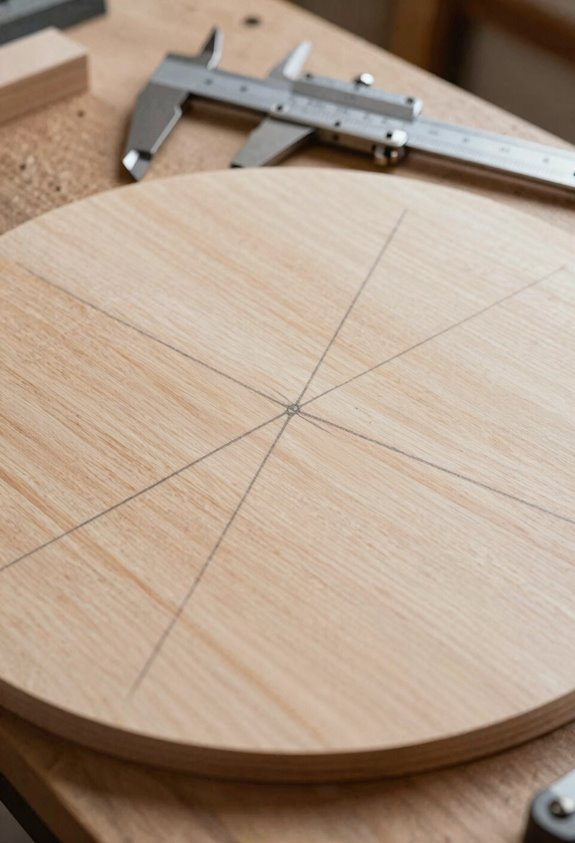
When you’re working with a circular piece of wood and need to find its exact center, drawing chords—straight lines across the circle—is one of the most reliable methods. I’ll walk you through this step-by-step approach.
First, draw several chords near the circle’s edge. Then find each chord’s midpoint and use a square to draw perpendicular bisectors extending toward the center. These perpendicular lines create your roadmap.
Draw chords near the circle’s edge, find their midpoints, and use perpendicular bisectors to create your roadmap to center.
Draw perpendicular bisectors from multiple chords. They’ll converge near the center, and that intersection point is your target. When your perpendicular bisectors consistently meet within about 1/16 inch across different chords, you’ve got excellent accuracy.
More chords mean better precision. Once you’ve pinpointed the center, you’re ready to drill your pilot hole for a circle-cutting jig, guaranteeing perfectly centered workpieces every time.
Method 2: The Quick Framing Square Technique
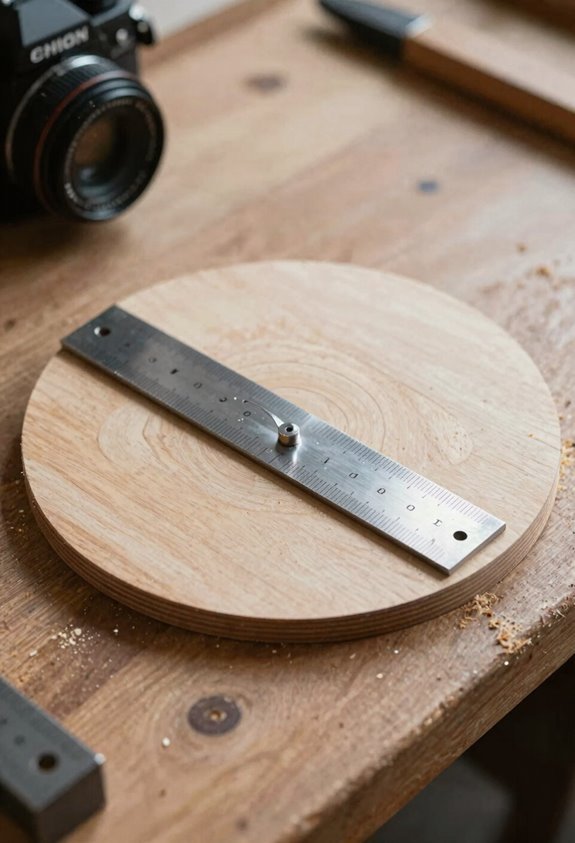
How can you find a circle’s center without drawing multiple lines all over your workpiece? Grab a framing square, it’s a helpful shortcut. Place one leg along a chord, positioning the corner at the chord’s midpoint. Rotate the square so the second leg creates a perpendicular line extending inward toward where you suspect the center of circle sits.
That’s one perpendicular down. Now repeat with a different chord. Where these two perpendiculars intersect? That’s your center. Want accuracy? Add a third chord and its perpendicular. If all three lines meet at the same spot, you’ve nailed it.
This method beats drawing multiple chords because it’s faster and relies on one simple tool you likely already own.
Method 3: Using a Compass and Arc Intersections
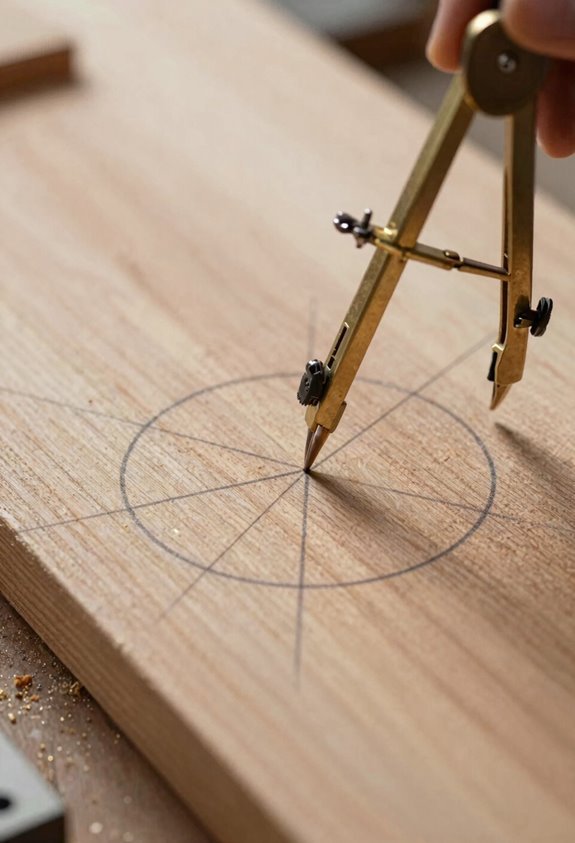
If you’re looking for a method that’s a bit more precise than the framing square approach, grab your compass—the drawing tool, not the navigation kind.
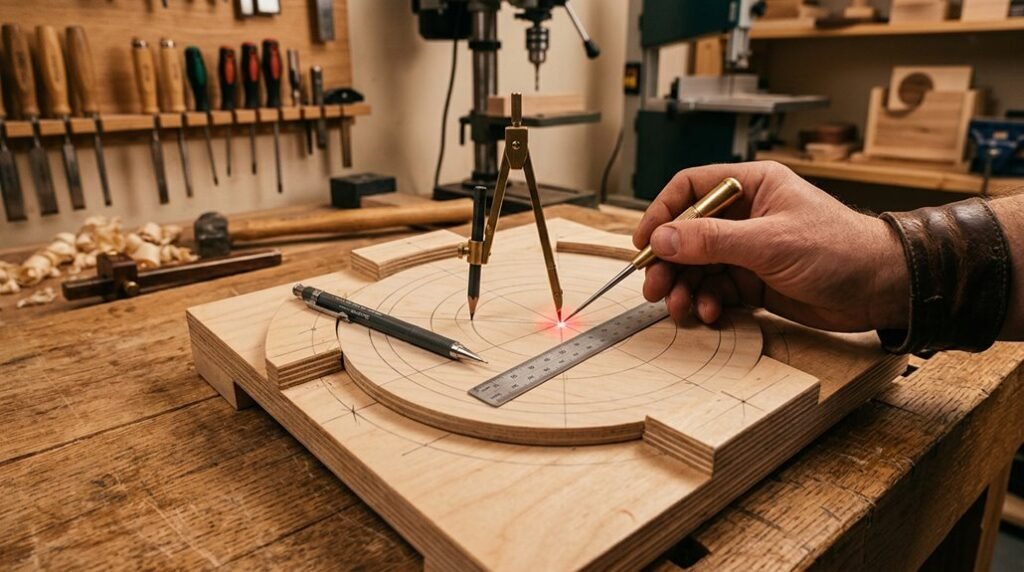
Set your compass to a radius smaller than your circle’s estimated size. From one perimeter point, draw arcs both inside and outside the circle. Move to another nearby point and repeat, creating intersecting arcs.
Set your compass to a radius smaller than your circle’s estimated size, then draw arcs from multiple perimeter points to locate intersections.
Use a straightedge to connect where these arcs cross; you’ve just drawn a diameter. Repeat this process from different perimeter points to locate additional diameters.
Where your diameters intersect, you’ve found your center point. This method works because arcs from multiple circle locations converge only at the true center. You can feel confident knowing this geometric principle backs your woodworking accuracy.
Method 4: The Straightedge and Chord Midpoint Shortcut
Ever notice that a radius always meets a chord at a perfect right angle? That’s your key advantage for finding the center.
Here’s what I do: I mark two chords on my circle, then find each midpoint. Using a straightedge, I draw a perpendicular bisector through each chord midpoint. These lines point directly toward the center, and where they intersect is your center point.
| Step | Action | Purpose | Result |
|---|---|---|---|
| 1 | Mark two chords | Establish reference lines | Two chords identified |
| 2 | Find midpoints | Locate perpendicular points | Two midpoints marked |
| 3 | Draw perpendiculars | Create center lines | Lines pointing inward |
| 4 | Find intersection | Locate exact center | Center point confirmed |
I verify with a third chord. This method is more straightforward than fussing with compasses and delivers reliable results.
Verify Your Results: Testing Accuracy With a Compass
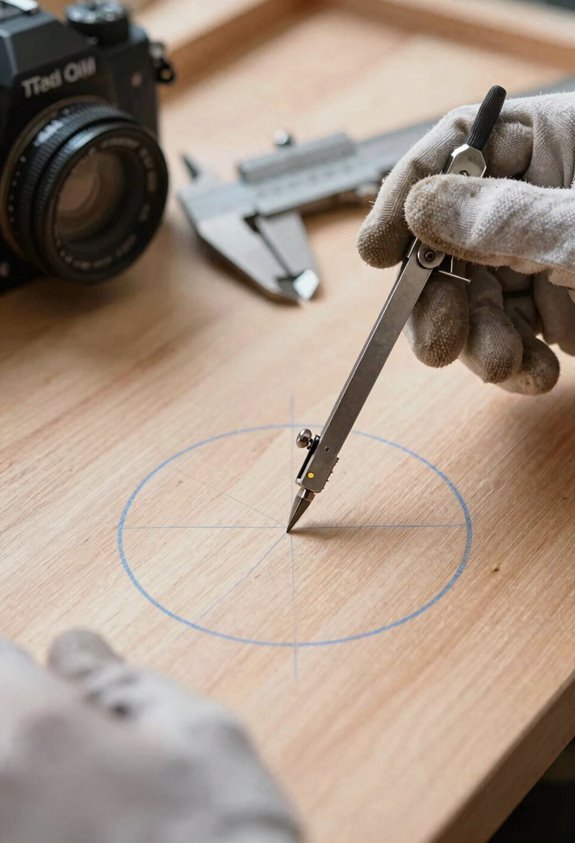
Now that you’ve found your center point using perpendicular bisectors, don’t just assume it’s correct. You’ll want to confirm it actually works. Here’s how I verify my results using a compass.
Set your compass to reach from the center to the circle’s edge. Then rotate it around, checking that the pencil point touches the perimeter everywhere. If it does, you’re good.
I also measure the distance from my center to several points on the circle. They should all match within a small tolerance. I aim for within 1/16 inch, which is plenty accurate for woodworking.
For smaller circles, I’ll draw a third diameter and confirm all three meet at the same spot. This extra check catches mistakes before they cost you material and time.