wood moves way more because of moisture than temperature. I know that sounds counterintuitive—heat makes most things expand, right? But wood’s different.
When humidity rises, wood absorbs moisture like a sponge, and that’s what actually makes it swell. The catch? It doesn’t expand equally in all directions, and that difference matters hugely for builders and woodworkers.
Moisture, Not Temperature, Drives Wood Movement
Have you ever wondered why a wooden door sticks in summer but slides freely in winter? I’ll tell you why: it’s not temperature, it’s moisture.
Wood absorbs and releases water based on relative humidity, the amount of moisture in the air around it. As humidity changes, wood experiences moisture exchange with its surroundings, triggering wood movement. For every 5% change in relative humidity, wood’s moisture content shifts about 1%.
Your wood naturally seeks equilibrium moisture content, the moisture level that matches its environment. When humidity rises, wood absorbs water and expands. When humidity drops, it releases water and shrinks.
Temperature only matters indirectly. Heat dries air, increasing humidity differences that drive movement faster. So next time your wood shifts, you’ll know moisture wrote the story.
How Moisture Content Triggers Expansion and Contraction
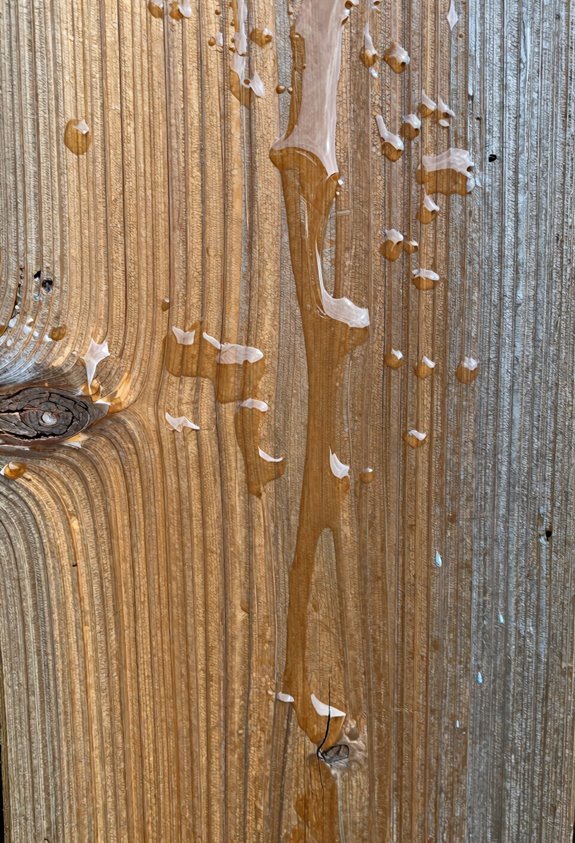
When wood absorbs moisture from humid air, water molecules wedge between wood fibers and force them apart, this is swelling. When that moisture evaporates, the fibers shrink back down. Your wood doesn’t keep expanding and contracting forever, though; it eventually reaches equilibrium moisture content (EMC), which is the moisture level where wood stops exchanging water with its surroundings because the humidity around it has stabilized.
Think of EMC as your wood’s comfort zone: a basement in winter might have 12% EMC, while a humid kitchen could push it to 14%, and your wood will continuously adjust to match whatever environment it’s in.
Moisture Absorption and Swelling
Why does wood behave like a sponge? Wood absorbs moisture from humid air, causing it to swell. Here’s what happens:
- Moisture enters the wood – When humidity rises, water vapor penetrates the wood cells, increasing moisture content (MC).
- Swelling begins below the fiber saturation point – Once MC drops below 26–30%, bound water moves within the wood structure, causing expansion that we call swelling.
- Equilibrium moisture content is reached – Your wood eventually matches the surrounding humidity, stabilizing at an equilibrium where swelling stops.
You’ll notice wood swells most noticeably when MC changes significantly. A 5% relative humidity shift typically triggers about 1% MC change. Understanding this relationship helps you predict how your wood will behave in different seasons and environments.
Equilibrium Moisture Content Balance
Ever wonder why your wooden door sticks in summer but swings freely come winter? That’s equilibrium moisture content (EMC) at work. Your wood naturally seeks balance with surrounding humidity levels through constant moisture exchange. When indoor humidity climbs to 65%, your wood absorbs moisture and swells. When it drops to 25%, your wood releases moisture and shrinks.
This dimensional movement happens because wood fibers respond directly to humidity changes. Below the fiber saturation point (around 26–30% moisture content), bound water loss triggers shrinkage. Above it, free water dominates. Indoor RH swings typically cause about 6% moisture-content variation, driving noticeable expansion and contraction across the grain.
This process continues throughout wood’s lifetime. Your furniture never truly stops adjusting to its environment.
The Three Directions of Wood Movement: Which One Matters Most
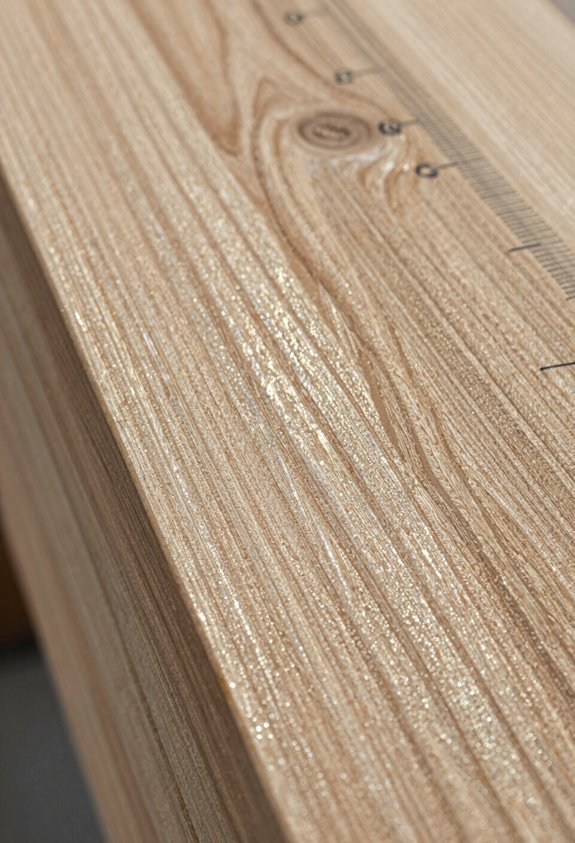
How much does wood actually move? The answer depends on which direction you’re looking at. Wood shrinks and swells in three distinct ways, and here’s what matters most:
- Tangential movement – the greatest at up to 8% from green to dry, happening along the growth rings
- Radial movement – moderate at around 4%, occurring across the wood’s rays
- Longitudinal movement – nearly negligible at 0.1%, running along the grain’s length
Width changes dominate your woodworking decisions. Your grain orientation and whether you’ve chosen flat-sawn or quarter-sawn lumber will determine how much your project moves.
Understanding these three directions lets you predict behavior, plan stable joints, and avoid costly mistakes when moisture shifts.
Flat-Sawn vs. Quarter-Sawn: Which Grain Pattern Moves Less?
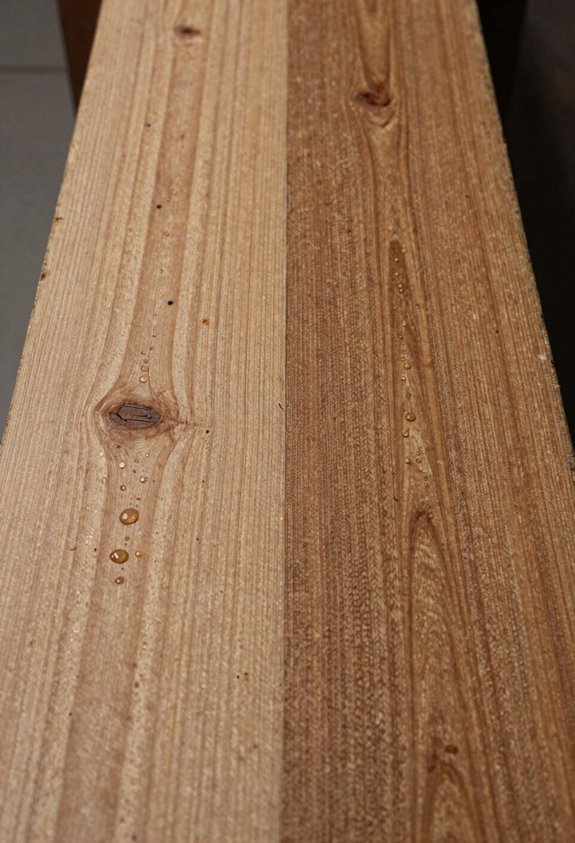
You’ll notice that how a board is cut from the tree dramatically changes how it behaves when moisture shifts; the grain orientation itself acts like a blueprint for movement. Flat-sawn boards, which are cut parallel to the growth rings, expand and contract up to 40–50% more across their width than quarter-sawn boards, and they’re notorious for cupping (warping into a curve) as they dry.
Quarter-sawn boards, cut perpendicular to those same growth rings, give you significantly less width movement and stay flatter, making them the go-to choice whenever you need a board that’ll stay put.
Grain Orientation Affects Movement
Why do some wooden boards stay flat and stable while others cup and warp like potato chips? The answer lies in grain orientation, how the wood’s growth rings are cut affects how much it moves.
Here’s what happens with different cuts:
- Flat-sawn boards expand about 40–50% more across their width than quarter-sawn boards when moisture changes
- Quarter-sawn boards move only half as much width-wise, staying noticeably flatter overall
- Cupping differs too: flat-sawn end grain cups as sapwood shrinks faster than heartwood, while quarter-sawn mainly widens without cupping
The key is tangential movement, the dominant factor across the grain, which varies dramatically between cuts. Longitudinal movement along the grain stays minimal for both.
When you choose quarter-sawn wood, you’re choosing stability and flat surfaces that’ll last.
Flat-Sawn Cupping And Warping
When flat-sawn boards dry out, they don’t shrink evenly, and that’s where the trouble starts. Picture wood shrinking like a wringing-out sponge: the outer edges dry faster than the center, creating uneven stress. This moisture content difference causes cupping, where boards bend into a U-shape, and warping, a general twisting distortion.
The culprit is grain orientation. Flat-sawn wood shrinks roughly 1.4 times more across its width than quarter-sawn wood when moisture levels drop. Because annual rings curve toward the outer edge, they pull the surface tighter, forcing the board to cup opposite the grain direction.
Quarter-sawn boards resist this problem because their grain runs nearly perpendicular to both faces, creating more even shrinkage. If you’re building furniture or cabinets, this difference matters considerably.
Quarter-Sawn Stability And Performance
Now that you understand why flat-sawn boards cup and warp, here’s the good news: quarter-sawn wood offers a real solution to this problem.
Quarter-sawn boards are cut differently, which changes how they respond to moisture. Here’s what makes them superior:
- Less across-width movement — Quarter-sawn wood moves roughly half as much as flat-sawn wood when moisture changes, keeping your projects more stable
- Resists cupping — The grain pattern runs differently, so the board stays flatter instead of developing that annoying cup
- End-grain behavior — Instead of cupping like flat-sawn boards, quarter-sawn ends mainly widen slightly
For the same moisture change, flat-sawn boards can move 40–50% more. That’s significant.
If you’re serious about dimensional stability and want wood that holds its shape, quarter-sawn’s superior movement control makes it worth considering, even if it costs more.
How Wood Changes Shape as It Dries
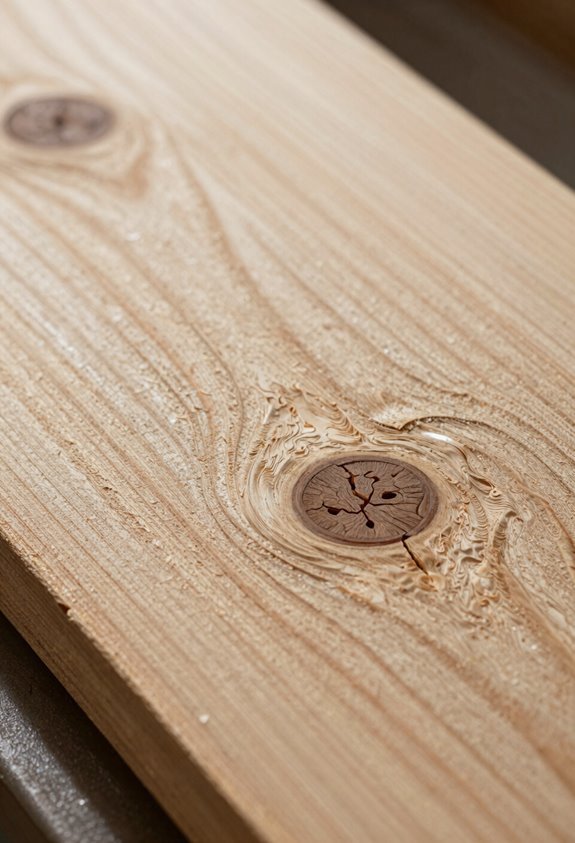
Have you ever noticed a wooden door that sticks in summer but closes smoothly in winter? That’s wood responding to moisture content changes. When wood dries, it shrinks unevenly across its grain. Understanding this helps you predict dimensional changes in your projects.
| Movement Type | Percentage | Direction |
|---|---|---|
| Tangential | ~8% | Across grain |
| Radial | ~4% | Toward center |
| Longitudinal | ~0.1% | Along length |
| Fiber saturation | 26-30% MC | Shrinkage begins |
| Equilibrium point | Variable | Seasonal balance |
Wood reaches equilibrium moisture content when it stops exchanging moisture with air around it. This seasonal shift means your 6-inch board might shrink 1/32 inch in winter.
The grain’s orientation matters too. Tangential movement causes more dramatic changes than radial movement, which is why board orientation affects how pieces warp or cup during the drying process.
The Rule of Thumb: Estimating Movement for Your Project
So how much will your wood actually move? I’ve got a practical formula that helps you predict wood movement for your projects.
Here’s what you need to know:
- Flat-sawn lumber shrinks about 1/4 inch per 12 inches of width as moisture content drops
- Quarter-sawn lumber moves roughly half that, about 1/8 inch per 12 inches, because of its grain orientation
- Seasonal humidity swings typically cause 6% moisture fluctuation, creating noticeable but manageable shifts
A 6-inch-wide board might shrink just 1/32 inch during winter, which sounds tiny but matters for tight joints. The key difference is that flat-sawn wood moves 1.4 times more across width than quarter-sawn for identical moisture changes.
Understanding this distinction between grain cuts lets you choose the right lumber and plan your layout confidently.
Which Woods Expand and Shrink Most (and Least)?
Not all woods behave the same way when moisture levels change; some species shrink and swell dramatically while others barely budge. I’ll show you which woods give you the most headaches, like beech and maple, which can move up to 8% tangentially, and which stable alternatives keep your projects looking tight and flat over time.
Understanding these differences helps you pick the right wood for your situation and know how much expansion space you’ll actually need.
High-Movement Wood Species
Because wood’s grain structure directly determines how much it’ll expand and contract, understanding which species move the most and which barely budge is essential for your woodworking projects.
High-movement species like Maple, Hickory, and Beech require careful planning. Here’s why they’re trickier:
- Tangential expansion reaches ~8% when wood moves from green to fully dried, making these species particularly sensitive to humidity changes
- Flat-sawn boards move twice as much as quarter-sawn grain, so selecting your cut matters significantly for equilibrium moisture content stability
- Radial shrinkage (~4%) still affects wood movement, though less dramatically than tangential movement
These high-movement species need wider gaps during installation and more acclimation time in your workshop. Understanding wood movement prevents warping, cupping, and joint failure, keeping your projects looking great for years.
Stable Wood Alternatives
If you’re tired of babysitting high-movement woods, I have good news: plenty of stable species exist that will cooperate with your projects. Mahogany, walnut, cherry, and teak rank among the best, showing excellent stability with low movement coefficients. These woods resist dimensional change better than beech or oak, which display pronounced end-grain expansion and mid-range stability respectively.
Quarter-sawn cuts are your best option. This radial orientation moves 1.4× less than flat-sawn lumber across width, dramatically reducing cupping and warping. When combined with naturally stable species variation, you’re looking at serious reliability.
| Species | Stability | Best Cut |
|---|---|---|
| Mahogany | Excellent | Quarter-sawn |
| Walnut | Good | Quarter-sawn |
| Ipe | Superior | Either |
Choose wisely, and your projects stay put.
Designing Tabletops, Floors, and Wide Boards to Accommodate Movement
How do you keep a beautiful tabletop from cracking or warping as seasons change? I’ll show you how smart design prevents wood movement problems.
Here’s what I recommend:
- Choose quarter-sawn wood because it moves 40–50% less than flat-sawn boards across its width, making it ideal for tabletops.
- Use floating fasteners and support rails like C-channel underlays that let wood shift freely without restriction.
- Plan expansion gaps along edges and avoid gluing boards end-to-end, which blocks seasonal humidity changes.
Before installation, acclimate your tabletop to local moisture content conditions. A 40-inch walnut top might move roughly 1/10 inch per direction with typical seasonal shifts.
This board orientation and acclimation strategy protects your investment from seasonal humidity swings.
Joinery Techniques That Let Wood Move Freely
While thoughtful design and acclimation set the stage for a stable tabletop, the joints holding your pieces together are where the real work happens. I’ll show you how to build joinery for moisture tolerance that actually works.
The key is to let wood move. Floating panels aren’t held rigidly; they’re supported but free to shift. Slip joints create gaps that accommodate expansion without forcing the wood. Movement joints deliberately space pieces apart, typically 1/8″ to 1/4″ per 12″ across the grain.
Use slotted fasteners and knock-down hardware instead of fixed screws. Biscuits work well if you leave room for sliding. Avoid end-to-end fixed joints entirely, as they’ll bind and crack.
Think segmented connections: multiple shorter spans distribute stress rather than concentrating it. This approach keeps your work stable through seasons.
Why Seasonal Humidity Creates Predictable Movement Cycles
Why does your tabletop swell in summer and shrink in winter? It’s all about relative humidity, the moisture in your air. Your wood constantly seeks equilibrium moisture content, or EMC, exchanging moisture with its surroundings.
Wood constantly seeks equilibrium with surrounding moisture, causing seasonal swelling and shrinking driven by humidity shifts.
Here’s what drives seasonal movement:
- Summer humidity rises – Wood absorbs moisture, swelling across the grain by roughly 0.5–1%
- Winter humidity drops – Wood releases moisture, contracting as it dries
- Location matters – Eugene, Oregon experiences ~8.9% annual moisture swings, while Santa Barbara sees only ~2.5%
This predictable cycle happens because wood’s cell structure responds directly to humidity changes, not temperature. Indoors, you’ll typically see 2–4% moisture content swings annually.
Understanding this pattern helps you anticipate how your boards will behave and why board orientation affects expansion direction. You’re now part of the woodworking community that plans ahead.
Should You Try to Eliminate Wood Movement?
| Strategy | Best For |
|---|---|
| Acclimation | Letting wood adjust before building |
| Stable cuts | Quartersawn (less cupping) |
| Strategic joints | Allowing expansion room |
| Gaps & spacing | Preventing buckling |
Smart woodworkers work with moisture content shifts rather than against them. Choose quartersawn boards when stability matters most. Build joints and gaps that let your wood move seasonally.
This approach keeps your projects looking good year-round without stress cracks or warping. Accommodate wood movement, and you’ve joined a community that builds things lasting decades.