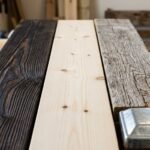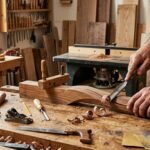
Did you know most people abandon DIY projects because they take too long? Here’s the good news: you don’t need weeks to build something useful. I’m going to show you nine solid projects, from a wooden chopping board to closet shelves, that you can actually complete in an afternoon.
Each one uses basic tools and simple techniques, so whether you’re a beginner or returning to the workshop, you’ll find something that fits your skill level and schedule. Let’s explore what’s possible.
Make a Wooden Chopping Board and Serving Tray
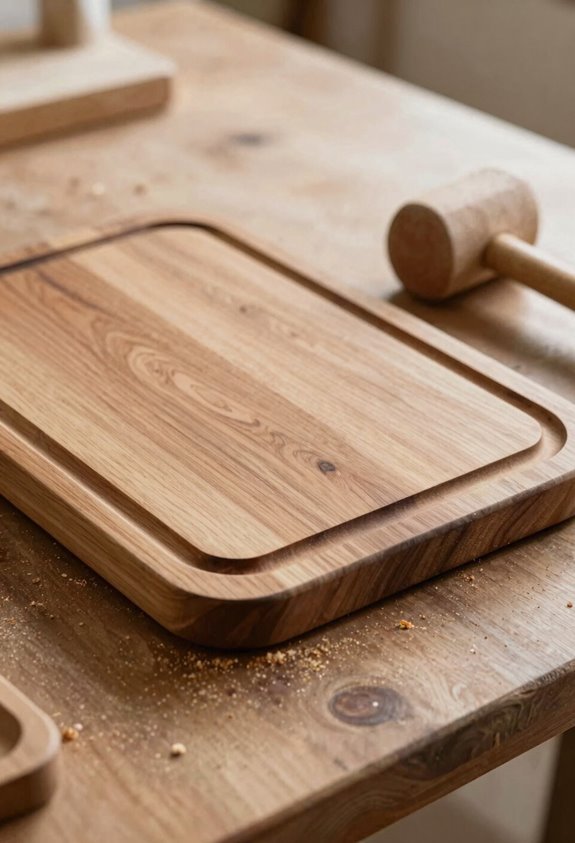
Want to build something useful that’ll actually get used in your kitchen? A wooden chopping board and serving tray is the perfect woodworking starter project you’ll finish in one session.
Your process:
- Dry-fit all parts first to check alignment
- Use a 4-ft steel ruler to scribe arcs for curved edges
- Apply water-resistant wood glue, keeping boards level during assembly
- Sand surfaces smooth once glue dries
Add your chosen finish for durability once the surfaces are prepared.
Keep it food-safe: Never run finished boards through the dishwasher. Hand wash instead to protect glue joints and wood finish.
This beginner-friendly build requires only basic tools and delivers a functional kitchen piece you’ll actually use.
Build a Dual-Purpose Shoe Storage Stool in One Hour
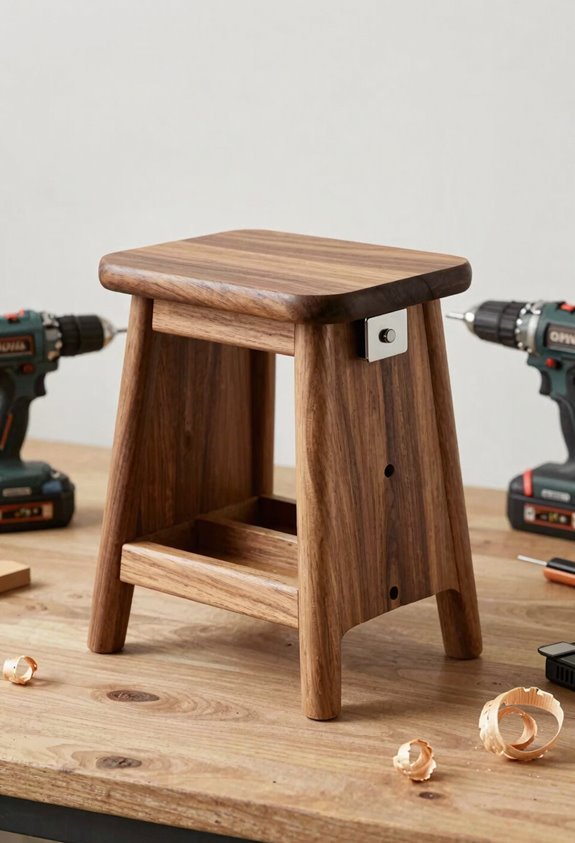
If you’re short on time and space, I’ve got the perfect beginner project for you: a dual-purpose shoe storage stool that you’ll actually finish in about an hour.
Short on time and space? Build a dual-purpose shoe storage stool in about an hour—the perfect beginner project.
You’ll need just one 4 ft. by 4 ft. plywood sheet, wood glue, and 18 screws. Using a table saw to cut your boards simplifies the work considerably. Start by gluing your joints, then screw everything together securely.
The benefit here? You’re creating both a comfortable seat and hidden storage for your shoes in one compact unit. Perfect for entryways or closets where space matters.
Assembly’s straightforward: glue, screw, done. Optionally mount it to your wall for extra stability.
This project proves you don’t need fancy tools or complex designs to build something useful. You’re joining a community of makers who value practical, quick wins.
Build a Budget-Friendly Bench in One Afternoon
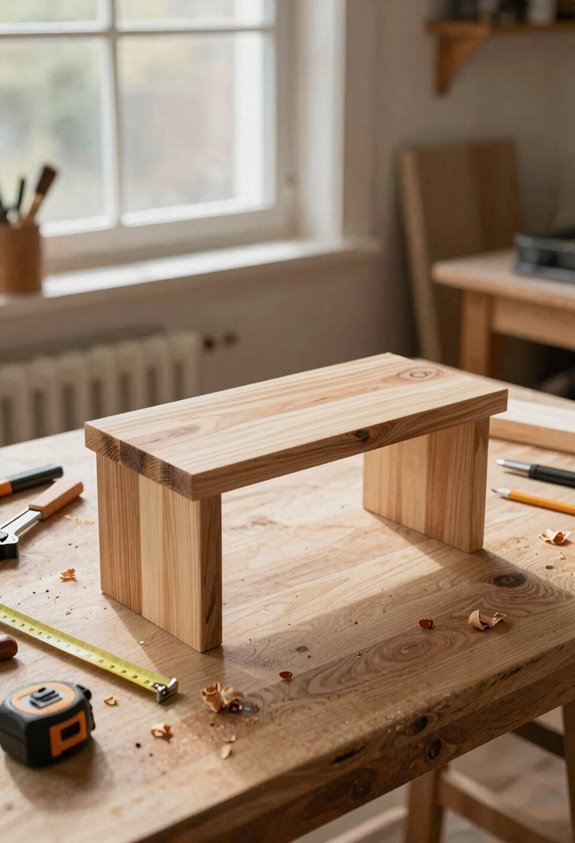
You’ll want to gather just two boards and 18 screws, plus basic tools like a drill and saw, to get this bench built without breaking the bank. I’ll walk you through the straightforward assembly steps that’ll have your bench ready for sitting in just a few hours, using simple fastening methods that even beginners can handle.
Once you understand how these pieces fit together, you’ll see why this project is perfect for improving your woodworking skills without the complexity.
Materials and Tool Requirements
Building this budget-friendly bench doesn’t demand a workshop full of expensive equipment or exotic materials. You’ll need just two boards of 3/4-inch thick lumber—pine works great—plus 18 screws and wood glue. That’s it for materials.
For tools, gather what you probably already have: a saw (hand or power), a drill/driver, measuring tape, a square, clamps, and a screwdriver bit. These essentials let you complete woodworking projects without breaking the bank.
After assembly, apply a simple finish like wipe-on oil or water-based polyurethane to protect your work. This straightforward approach means you’re not hunting specialty items or spending hours on prep. You’ll join countless builders who’ve discovered that basic materials and fundamental tools create solid, functional seating without fancy equipment.
Step-by-Step Assembly Instructions
Now that you’ve gathered your materials and tools, it’s time to put them to work. I’ll walk you through assembling your woodworking project step-by-step.
| Step | Action | Time |
|---|---|---|
| 1 | Arrange boards and apply wood glue | 15 min |
| 2 | Clamp pieces to align edges | 10 min |
| 3 | Pre-drill holes to prevent splitting | 20 min |
| 4 | Drive screws through top and sides | 30 min |
| 5 | Apply finish and let dry | 45 min |
First, I arrange my 2×12 seat boards and leg pieces. I apply glue to joints, then clamp everything together, keeping edges perfectly aligned. This prevents frustrating gaps later.
Next, I pre-drill holes. This stops wood from splitting when screws go in. Then I drive my 18 screws through the top and side components. Finally, I wipe on polyurethane, creating a natural-looking protective finish. You’re done!
Build a Wall-Mounted Shoe Rack for Boots and Sandals
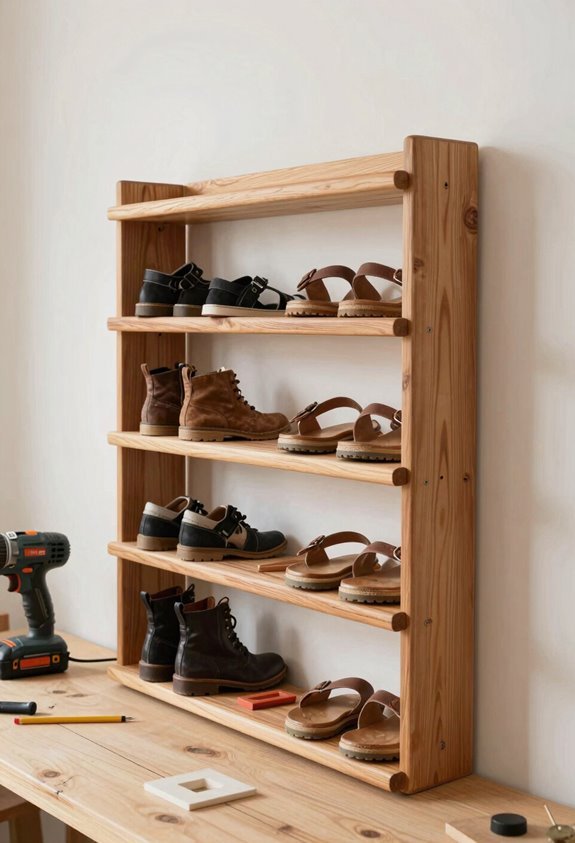
Where does all your footwear end up by nightfall? A wall-mounted shoe rack solves that problem while keeping your entryway organized. This woodworking project is ideal for beginners and takes just a few hours to complete.
A wall-mounted shoe rack solves footwear clutter while keeping your entryway organized—an ideal beginner woodworking project.
Build a compact 24-inch wide by 36-inch tall unit using 3/4-inch plywood. Space vertical dividers to accommodate boots and sandals comfortably. Mount directly to wall studs for strength.
Here’s your assembly process:
- Cut your back panel and side rails
- Add evenly spaced shelves or slots
- Pre-drill all holes to prevent splitting
- Glue and secure with nails or screws
- Install optional wall-hanging brackets for stability
Finish with water-resistant wood glue and clear polyurethane. Add a wipe-on sealer protecting against moisture from wet footwear. Your shoes finally have a home.
Get Three Shelves Out of One Board
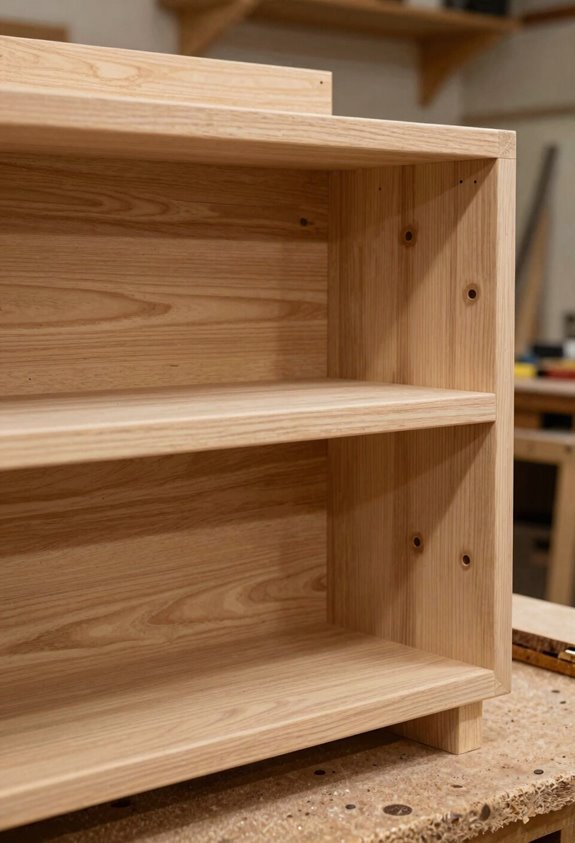
When you’ve got limited materials and big ambitions, one board can work triple duty. I’m talking about converting a single 3-ft. hardwood board into three functional shelves, a smart move for woodworking projects when time’s tight.
Here’s my approach: I cut a 21-in. segment and rip the remainder to create two shelves. The 45-degree bevels on the long front edges give them a polished look.
| Step | Tool | Result |
|---|---|---|
| Cut segment | Saw | 21-in. piece |
| Rip remainder | Table saw | Two shelves |
| Bevel edges | Router | Angled fronts |
I use dados for joining; those grooves hold everything secure. Beveled ends on the other board align perfectly. Clean glue-ups with accurate spacing produce a snug fit. You’ll finish this in one session, maximizing material while minimizing waste.
Build a Stacked Recycling Tower
If you’ve mastered making shelves from a single board, you’re ready for a project that puts those woodworking skills to work solving a real household problem.
I’m building a Stacked Recycling Tower, a compact sorting unit that’ll improve your recycling routine. Here’s what makes this project perfect for you:
- Uses just five plastic containers and six 2x2s
- Stands about 15 inches tall with containers sized 14-1/2 by 10 inches
- Requires only screws and basic drilling: two 5/32-inch holes per crosspiece
- Creates a modular design you can customize with wooden spoons or labels
The frame’s straightforward construction connects front and back panels with side crosspieces. Spacing the uprights to match container lips means everything fits snugly. You’ll join everything with inset screws for a polished look.
This project combines functionality with simplicity, giving you a sorting solution you’ll actually use.
Why You Need a Swedish Boot Scraper (and How to Build One)
I’ll show you how this traditional Swedish farm design works. It’s basically a wooden frame with sharp-edged slats that scrape mud and dirt right off your boots before you track it inside.
You’ll cut those slats to length (typically 3/8 inch thick) and arrange them in triangular openings along a pair of 2x2s, which gives you that aggressive scraping action you need for real cleanup. The sharp edges are what make this design so effective: as you drag your sole across them, they dig into packed mud and debris way better than a smooth surface could.
Traditional Swedish Farm Design
Before mud tracks its way through your home, a Swedish boot scraper does the dirty work for you, literally. This practical farm accessory reflects generations of smart design thinking from Scandinavian homesteads.
Here’s what makes this project perfect for your workshop:
- Uses common shop tools: radial arm saw, table saw, or band saw
- Requires basic materials: a wooden block base and galvanized screws
- Takes about four hours from start to finish
- Creates durable, repeatable results that protect your flooring
I build mine by crafting sharp-edged slats and attaching them to paired 2x2s, creating effective openings for dirt removal. Pre-drilled holes keep the assembly secure without splitting wood.
The design prevents footwear damage while standing up to repeated scraping. You’re joining a tradition that keeps homes cleaner and your entryways inviting.
Sharp Edges For Effectiveness
Why do sharp edges matter so much on a boot scraper? I’ll tell you: they’re what actually work. Dull slats just push mud around, while sharp ones dig in and remove it effectively. That’s why I keep the edges fairly sharp on my natural wood slats.
| Edge Type | Effectiveness | Maintenance |
|---|---|---|
| Sharp | High mud removal | Regular touch-ups |
| Rounded | Minimal scraping | Less frequent |
| Dull | Poor performance | Needs replacement |
When I’m building mine, I don’t over-sand the slat edges. A little roughness stays, which gives you better grip on that stubborn gunk. Using a bandsaw or table saw gives you crisp cuts that maintain sharpness naturally.
Pre-drill your screw holes so you don’t dull those edges during installation. That’s the trick to a boot scraper that actually does its job on your porch.
Stop Books From Toppling With Sliding Bookends
How do you keep a stack of books from tumbling across your shelf like dominoes? Sliding bookends are your answer. I’ll show you how to build them in under an hour.
Here’s what makes these bookends work:
- Cut two 6-inch square hardwood pieces for a low-profile design
- Drill a 1/4-inch slot along one edge to fit your shelf thickness
- Sand everything smooth to prevent snagging book edges
- Apply protective sealant for durability and finished appearance
The beauty of sliding bookends is their simplicity. They glide freely along 3/4-inch thick shelves without extra supports.
That slot keeps them aligned and prevents tipping from uneven loads. You’re joining a community of woodworkers who appreciate practical solutions. This project proves that effective doesn’t require complicated.
Build Two-Story Closet Shelves for Extra Space
When you’re working with a closet that feels cramped, adding a second shelf above your existing one uses wasted wall space for functional storage. Think of it like stacking two filing cabinets instead of using just one.
You’ll need to install sturdy support structures, typically 16-inch vertical supports that screw directly into wall studs or use drywall anchors for secure mounting. This gives you flexibility in choosing your shelf height based on what you’re storing. This smart approach lets you keep everyday items on the lower shelf while reserving that upper space for seasonal gear or things you don’t grab often.
Maximizing Vertical Closet Space
Since most closets waste the space above existing shelves, you can dramatically boost your storage capacity by building a second shelf level, creating a two-story closet system without taking up any extra floor room.
I’ve found that adding 12-inch-wide shelving makes good use of overhead space and keeps everything organized. Here’s what makes this closet shelving project work:
- Cut 16-inch supports to secure shelves firmly to wall studs or use drywall anchors
- Use adjustable heights so you can rearrange shelves as your needs change
- Store seldom-used items upstairs to free up accessible lower space
- Maintain your closet footprint while doubling storage density
The straightforward joinery and standard materials mean you’ll finish this weekend project quickly. I appreciate how this approach lets everyone access what they need while keeping everything organized vertically.
Installing Support Structures Properly
The key to a sturdy two-story closet system lies in getting your support structures anchored correctly to the wall. I’ll walk you through this critical step.
First, cut your supports to exactly 16 inches long. This measurement keeps your shelves properly spaced for comfortable access. Next, I secure the end supports directly to wall studs whenever possible, as they’re your strongest anchoring points.
If studs aren’t available where you need them, don’t worry. Use quality drywall anchors instead; they’ll hold your shelves securely.
Here’s my process:
- Measure and mark shelf heights carefully
- Position supports level using a spirit level
- Fasten front edge supports to prevent sagging
- Double-check everything before loading items
This foundation is important between wobbling shelves and a reliable storage system you’ll trust for years.
Adjusting Shelf Height Flexibility
How much extra storage could you gain by going vertical?
When you’re planning your two-story closet shelves, shelving height flexibility is an important advantage. You’ll position that second shelf exactly where it works best for your stuff. Here’s what makes this approach so practical:
- Adjust spacing based on what you’re storing; bulky items need more room
- Position shelves 16-24 inches apart for comfortable access
- Leave clearance between your new shelf and existing one
- Customize heights for seasonal clothing rotation
I recommend measuring your tallest items first, then working backward. Your 16-inch supports give you control without requiring carpentry skills.
Since you’re using drywall anchors, you won’t hunt for studs. This flexibility means you’re not locked into one configuration; you can adapt as your storage needs change throughout the year.
Build a Countertop Knife Block in 30 Minutes
Why spend money on an expensive knife block when you can build one yourself in half an hour? I’ll show you how.
Start with a solid hardwood like maple or beech; these woods resist dents and last forever. Cut your block to about 4 to 5 inches tall so you can grab knives easily.
Next, route or saw evenly spaced slots into the wood, making each slot roughly 1/2 to 3/4 inch wide. This spacing accommodates standard blade widths perfectly.
Glue a contrasting face or base to your block for stability. Finally, finish with mineral oil or Danish oil, a simple wipe-on treatment that protects the grain beautifully.
You have a custom knife block that beats store-bought alternatives.